
Regression Testing in Software Quality Assurance: Types, Tools, and Methodologies

Regression Testing has become an essential practice in Software Quality Assurance that guarantees the stability of the software during the evolution of the systems. In modern development environments, where applications are updated regularly with the help of new features, bug fixes, integrations, and changes in the infrastructure, there is a very high risk of unintentionally breaking existing functionality. Regression Testing mitigates this risk by checking the correct functioning of previously present features after the changes are made.
With the adoption of Agile, DevOps, and continuous delivery in organizations, Regression Testing has changed its character from an occasional activity for validation to a continuous quality discipline. QA teams are no longer dealing with testing of the static systems but are validating the products that are evolving weekly, daily, and sometimes even multiple times a day. Regression Testing in this situation becomes a significant factor in gaining trust and reliability and having predictable release cycles.
According to Wikipedia, Regression Testing typically accounts for the largest share of testing effort in commercial software development, as teams must repeatedly validate existing features after every change.
This blog explains Regression Testing in Software Quality Assurance in a clear and simple way. It covers what regression testing is, why it is important, its types, tools, methods, common challenges, and best practices. All the content is written based on our team’s real project experience, using practical examples and lessons learned from day-to-day QA work, not just theory.
TL;DR
- Regression Testing ensures existing functionality remains stable after software changes.
- Frequent releases increase regression risk, making continuous testing essential.
- Different Regression Testing types balance coverage, speed, and confidence.
- Automation enables scalable Regression Testing in Agile and DevOps environments.
- Well-chosen methodologies reduce defects and improve release reliability.
Key Points
- Regression Testing protects business-critical workflows from unintended code side effects.
- Unit, selective, partial, and full Regression Testing serve different change scenarios.
- Tools like Selenium, Cypress, Playwright, JUnit, and TestNG support automated regression.
- Risk-based, continuous, and hybrid methodologies optimize Regression Testing execution.
- Effective Regression Testing depends on process alignment, maintenance, and QA maturity.
What Is Regression Testing?
Regression Testing is regarded as one of the software testing methods that ensure the existing application functionality is working properly even though the codebase has been altered. The code modifications may include the addition of new features, bug fixing, performance improvements, code refactoring, configuration updates, or the integration of third-party components.
- New feature development
- Bug fixes
- Code refactoring
- Performance optimizations
- Configuration or environment changes
- Dependency or framework updates
The main objective of Regression Testing is to find out the unintended side effects brought about by these changes. Even minor code changes can create waves of interrelationships among the components, particularly in large and intricate systems. Regression Testing is the method of telling that a fault like this is not going to happen by the time the software is finally released.
In the area of Software Quality Assurance, Regression Testing functions as a proactive measure that secures and supports the business workflow and user experience through the entire software life cycle of development, testing, and deployment.
Did You Know?
Wikipedia notes that Regression Testing often represents the most time-consuming testing activity in commercial software projects, as teams must repeatedly validate existing functionality after every code change.
Also Read: Top 15 API Testing Tools Used by High-Performing QA Teams
Types of Regression Testing Used in Practice
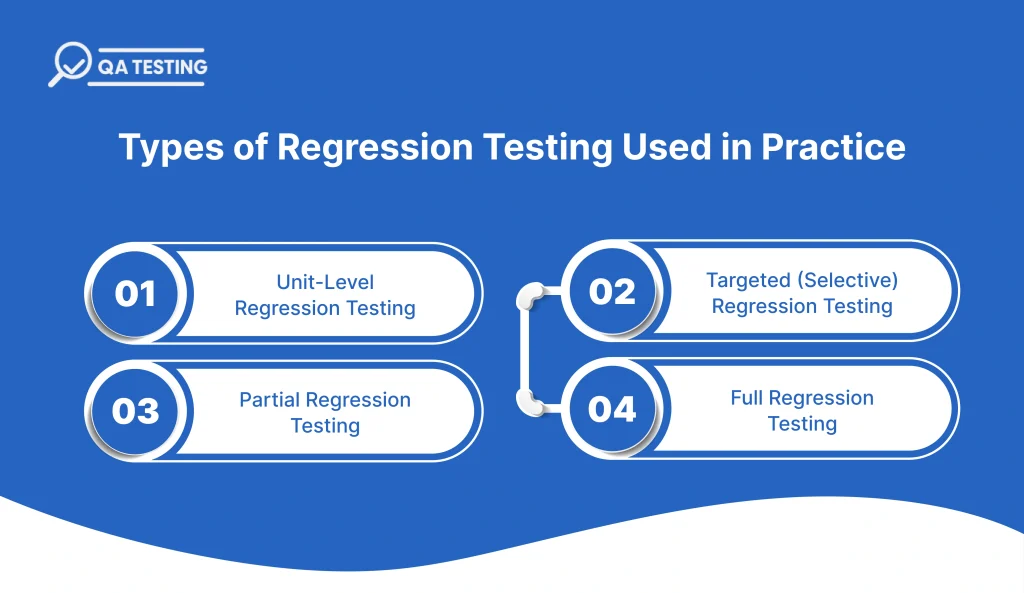
Depending on the extent of the change, complexity of the system, and the risk of the release, various kinds of Regression Testing are used in practice. Instead of one method, QA teams choose particular Regression Testing types to manage the coverage, execution time and confidence in a balanced way. The next parts will look through and briefly describe the approaches that are most often used in the course of Software Quality Assurance and also clarify when and why such a method is adopted.
1. Unit-Level Regression Testing
Unit-Level Regression Testing is performed on individual functions or components to check the correctness of logic in case of code changes. This process is mainly carried out by automated unit tests and placed as the first safety layer in the Regression Testing process by identifying defects before the code goes for integration or system testing.
- Detects regressions at the earliest development stage
- Reduces defect leakage into downstream QA cycles
- Validates business logic accuracy after changes
- Speeds up feedback for developers
- Strengthens overall Regression Testing effectiveness
2. Targeted (Selective) Regression Testing
The re-execution of just the test cases affected by the latest code modifications is the main feature of the Targeted Regression Testing. QA teams don’t run the entire regression suite; rather, they review the risk, dependencies, and the impact on business to point out the tests that matter; hence, this is the most efficient Regression Testing method for frequent releases.
- Reduces overall Regression Testing execution time
- Prioritizes business-critical workflows
- Uses impact analysis to select test cases
- Ideal for Agile and continuous delivery environments
- Maintains meaningful coverage with fewer resources
3. Partial Regression Testing
Partial Regression Testing is a method used to verify the compatibility of the current system functions with the new or changed features. It is a specific type of Regression Testing that ensures the upgrades or corrections are included without disturbing the established workflows; therefore, it is highly beneficial when changes are limited to certain areas but still linked.
- Confirms compatibility between new and existing features
- Prevents integration-related regressions
- Limits testing scope to affected areas
- Supports faster validation cycles
- Reduces unnecessary re-testing effort
4. Full Regression Testing
Full Regression Testing is the execution of the entire regression test suite to confirm that the overall system is stable after significant modifications have been made. This approach is often employed only in very risky situations where the highest possible trust is required, such as during major releases or when there are changes in the architecture.
- Provides the highest level of system assurance
- Validates end-to-end application stability
- Essential for major releases and migrations
- Identifies hidden cross-module regressions
- Requires significant time and resource planning
Regression Testing Tools Used by QA Teams
Automation is the main reason for Regression Testing to be able to repeat, be reliable, and scale easily. Manual-only Regression Testing is out of the question as one of the options for the QA teams since they have to deal with ever-increasingly complex software systems and shorter release cycles. Automation is the only tool that is capable of performing regression tests over and over without errors in the case of the various builds, environments, and platforms.
On the one hand, the selection of Regression Testing tools is dictated by such factors as application architecture, programming language, browser and platform requirements, team skill sets, and CI/CD integration needs. While on the other hand, the only good part about the tools provided is when they are implemented, maintained, and aligned with QA workflows in the right way.
To begin with, the most popular Regression Testing tools are presented below along with the actual usage of these tools by QA teams.
1. Selenium for Browser-Based Regression Testing
Selenium is among the most commonly used tools for web applications’ automated Regression Testing. It enables Quality Assurance departments to mimic real user activities in different browsers and OS.
Selenium is essentially a tool for carrying out repetitive regression tests that are always stable, such as login paths, checking out, filling out forms, and moving through the website. Thanks to its flexibility, it is still the best choice for extensive Regression Testing, especially for big companies that have to provide browser support.
However, Selenium requires strong framework design and ongoing maintenance. Without proper structure, Selenium-based Regression Testing suites can become slow and fragile over time.
2. Cypress for Fast Front-End Regression Testing
Cypress is a tool that is commonly used for front-end Regression Testing during those times when modern JavaScript-based applications are the most common ones. It is through quick execution and the delivery of real-time feedback during test runs that the tool is designed to work.
QA teams rely on Cypress to confirm UI behavior, component interactions, and important user journeys that are often influenced by front-end modifications. One of the reasons why Regression Testing done through Cypress is more trustworthy and quicker than that done through traditional browser automation tools is that Cypress operates directly in the browser context.
Cypress is especially effective for Agile teams that require quick regression feedback within short development cycles.
3. Playwright for Modern Cross-Browser Regression Testing
Playwright is increasingly adopted for Regression Testing in modern web applications. It supports multiple browsers and platforms using a single automation framework.
Regression Testing scenarios that need to show the same behavior regardless of the browser or device are executed by QA teams using Playwright. Its reliability and the waiting mechanisms provided help to eliminate flaky tests, which are one of the main problems faced in automated Regression Testing.
Playwright is able to serve particularly well for the applications that require a seamless experience to be provided for all the browsers, such as Chrome, Firefox, Safari, and mobile ones.
4. JUnit for Unit and Integration-Level Regression Testing
JUnit is primarily used for unit and integration-level Regression Testing in Java-based applications. It enables developers and QA teams to validate that individual components and service-level interactions continue to work after code changes.
JUnit-based Regression Testing aids in early detection of defects during the development cycle, which, in turn, lessens the amount of issues that get to the system-level testing. Although it does not take the place of total Regression Testing, it fortifies the entire testing strategy by avoiding the occurrence of low-level regressions.
Effective use of JUnit improves the stability and reliability of higher-level regression suites.
5. TestNG for Structured Regression Test Execution
TestNG is widely used for managing and organizing Regression Testing execution. It provides advanced features such as test grouping, prioritization, parallel execution, and detailed reporting.
QA teams use TestNG to structure large Regression Testing suites and control which tests run under different conditions, such as smoke regression, full regression, or release-specific validation. This flexibility allows teams to adapt Regression Testing execution to varying release scopes.
TestNG is often combined with Selenium or other automation tools to improve execution control and reporting visibility.
Also Read: User Acceptance Testing (UAT): Types, Benefits & Best Practices
Regression Testing Methodologies
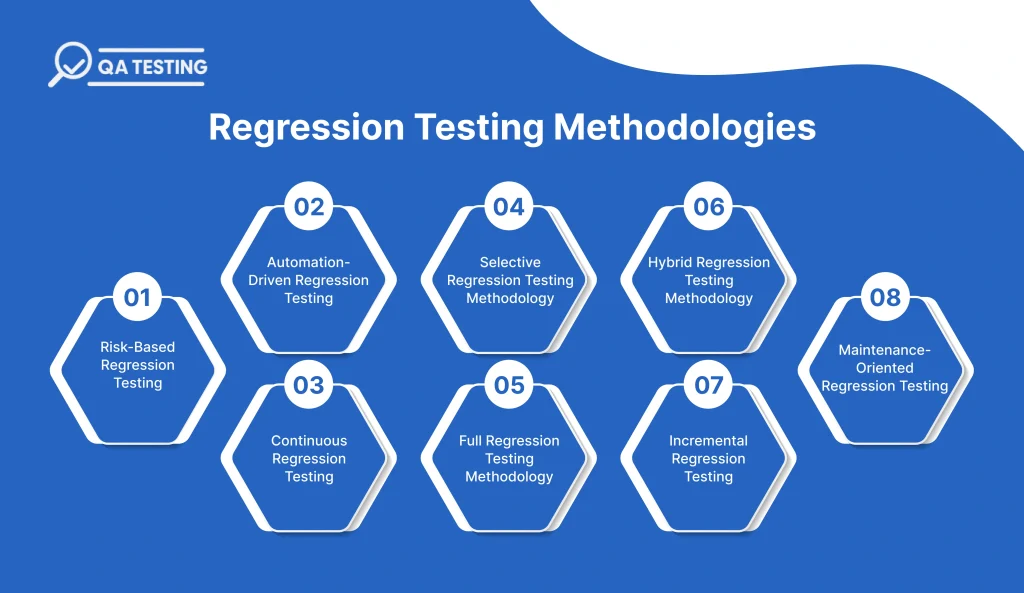
Regression Testing methodologies determine the way QA teams organize, plan, prioritize, and carry out regression testing throughout the software changes. Choosing the correct methodology is extremely important to attain a good balance between coverage, speed, and confidence in the release. However, in reality, the majority of organizations do not depend on just one methodology; rather, they employ a systematic mix that is dictated by the aforementioned factors of system complexity, release frequency, and risk exposure.
Below are the most effective Regression Testing methodologies used in Software Quality Assurance.
1. Risk-Based Regression Testing
Risk-Based Regression Testing is among the most commonly accepted methods in QA practices. It is based on the principle of doing testing selectively with the emphasis on business impact, usage frequency, and failure probability rather than doing it in an equal manner across the board.
How it works in practice:
- Identify business-critical user journeys
- Assess technical and functional risk areas
- Rank test cases based on potential impact of failure
- Execute high-risk test cases first within the regression cycle
Why it works:
This methodology ensures maximum protection of critical functionality when time and resources are limited. It is especially effective for enterprise applications with large test suites and frequent releases.
2. Automation-Driven Regression Testing
Automation-Driven Regression Testing treats automation as a core quality asset rather than a secondary activity. In this methodology, stable and repetitive regression scenarios are automated to enable fast and consistent execution.
Key characteristics:
- Automated execution of core regression suites
- Integration with CI/CD pipelines
- Regular maintenance of automation scripts
- Manual testing reserved for exploratory and UI validation
Practical benefits:
Automation-driven regression significantly reduces execution time and human error, making it ideal for Agile and DevOps environments where regression testing must run frequently.
3. Continuous Regression Testing
Continuous Regression Testing embeds regression checks directly into the software delivery pipeline. Instead of waiting for a dedicated testing phase, regression tests run automatically with every code commit or build.
Implementation approach:
- Regression suites triggered by CI pipelines
- Immediate feedback on failures
- Defects detected close to the point of change
- Faster root cause analysis
Best suited for:
Teams practice continuous integration and continuous deployment, where early defect detection is critical to maintaining delivery speed.
4. Selective Regression Testing Methodology
Selective Regression Testing focuses on executing only those test cases that are directly impacted by recent changes. This methodology relies heavily on impact analysis and dependency mapping.
Execution steps:
- Analyze code changes and affected components
- Map changes to functional areas
- Select relevant regression test cases
- Skip unrelated test scenarios
Advantages:
- Reduced regression cycle time
- Efficient use of QA resources
- Faster release validation
This methodology is particularly effective for large systems where full regression is impractical for every release.
5. Full Regression Testing Methodology
Full Regression Testing involves executing the entire regression test suite without exclusions. This methodology is typically used when risk exposure is high.
Common use cases:
- Major product releases
- Architectural or framework changes
- Platform migrations
- High-impact production fixes
Trade-offs:
While full regression offers the highest confidence, it requires significant time and resources. QA teams use this methodology selectively rather than for every release.
6. Hybrid Regression Testing Methodology
The Hybrid Regression Testing methodology combines multiple approaches to achieve optimal results. Most mature QA organizations adopt this model.
Typical hybrid structure:
- Automated regression for core business flows
- Risk-based prioritization of test execution
- Selective regression for minor changes
- Manual regression for UI and exploratory scenarios
Why it is effective:
Hybrid regression provides flexibility, scalability, and reliability, making it suitable for complex enterprise systems with varying release scopes.
7. Incremental Regression Testing
Incremental regression testing is applied in Agile environments, where features are delivered in small increments.
How it works:
- New test cases added alongside new features
- Existing regression tests executed incrementally
- Regression suite evolves sprint by sprint
This methodology ensures continuous quality validation without large regression bottlenecks at release time.
8. Maintenance-Oriented Regression Testing
This methodology focuses on keeping the regression test suite lean, relevant, and maintainable over time.
Key activities include:
- Removing obsolete or redundant test cases
- Refactoring automation scripts
- Updating test data and environments
- Reviewing regression effectiveness metrics
Maintenance-oriented regression prevents test suite bloat and improves long-term efficiency.
Also Read: Best AI Testing Tools for Smarter Testing
Choosing the Right Regression Testing Methodology
There is no single best Regression Testing methodology for all teams. The right approach depends on multiple practical factors that influence testing scope, execution speed, and confidence in releases.
The selection of a Regression Testing methodology depends on:
- Application complexity: Highly integrated and bigger systems will certainly need structured, risk-based or continuous Regression Testing to manage the impact that is widespread among different modules.
- Release frequency: Automation and selective Regression Testing will help release frequent teams to stay fast without the risk of losing stability.
- Risk tolerance: Applications that are very sensitive to failures require thorough and extensive Regression Testing coverage.
- Team maturity: Experienced QA teams can manage advanced Regression Testing methodologies such as hybrid or continuous testing more effectively.
- Automation readiness: Regression Testing can be scaled across builds and environments if there is a well-established automation framework.
Regularly improving and changing their Regression Testing methods according to the assessment of the development practices, system complexity, and business priorities, all high-performing QA teams do it continuously.
Conclusion
Regression Testing is one of the most important processes in Software Quality Assurance, which guarantees the stability of the software as different functionalities keep changing frequently. A practical Regression Testing technique chooses the testing types, tools, and methodologies based on actual delivery constraints and not just the theory alone. When carried out in a proper manner, Regression Testing diminishes the risk of release, stops the flow of defects to the customers, and creates a trust in the quality of the software that lasts.
Companies that work with skilled QA professionals get a huge advantage in the ability to use reliable and flexible Regression Testing methods. QA Testing, for instance, provides assistance with the help of organized techniques, automation, and consistent progression. Doing so helps the company maintain the high quality of the software while rapidly delivering it in the current Agile and DevOps environments.
FAQs
1. What is the importance of Regression Testing in Software Quality Assurance?
Regression Testing guarantees stability of the existing functionality after the code changes. Moreover, QA gets the chance to detect the side effects unintentionally caused by the changes very early, thus being able to eliminate them before the software is released to the customers, and also ensure that users having different software versions will experience the same quality of usability throughout the software lifecycle.
2. Which alterations require to perform Regression Testing?
The Regression Testing procedure has to take place after the ground-up changes, such as new features, user fixes, or configuration modifications. More commonly, it is a continuous process through automated pipelines in Agile and DevOps environments.
3. How do the two types of Regression Testing differ: full and selective?
Full Regression Testing is a type that covers everything to a little extent because it runs all tests in order to get the overall picture of the system’s stability, in contrast to selective Regression Testing, which only examines the affected parts, but its execution time is much less than full testing while still providing good coverage.
4. Is it possible to perform Regression Testing entirely through automation?
Not really, not to the full extent. While automated Regression Testing is essential for large-scale and fast-paced testing, manual testing is still necessary for exploratory validation, user-friendly checks, and constantly changing or highly complex scenarios that cannot be easily automated.
5. How can a software Quality Assurance company help with Regression Testing?
QA Testing, the vendor of QA services, is a strong ally in the coming up with effective Regression Testing strategies, setting up and keeping going automation frameworks, getting the highest possible test coverage, and interweaving regression workflows into CI/CD pipelines for dependable releases.

Pankaj Arora
Founder, AppShopo

Pankaj Arora is a seasoned technology leader and the Founder of QA Testing, with over 10+ years of experience in delivering high-quality software testing solutions. He specializes in quality assurance strategy, automated testing, AI-driven validation, and performance optimization. Under his leadership, QA Testing has become a trusted partner for startups and enterprises, ensuring secure, reliable, and seamless quality assurance across web, mobile, and enterprise applications.