Test Automation as a Service (TAaS): Benefits, Use Cases, Costs, and How to Choose the Right Vendor
Modern software is being developed faster than ever today, with companies adding new features every week and releasing dozens of updates every single day, which has led to increased expectations from end-users to have flawless experiences across all devices that they use. As such, traditional testing techniques have fallen behind the rapid pace of development and have contributed to slowing down release cycles, increasing the size of regression backlogs, and overspending on QA resources.
Test Automation as a Service represents an excellent opportunity for organizations to get additional support in automating their testing processes while still maintaining their own in-house automation projects. By leveraging the capabilities of experts who specialize in test automation, software companies can eliminate the development time associated with building an in-house test automation framework. It is not surprising that user feedback suggests that automated testing users captured an average of 90% more bugs earlier in their development cycles than did teams that relied only on manual testing methods. Furthermore, organizations can also reduce their overall costs related to QA once they begin to substitute automation for manual testing. Finally, automated testing cycles can run significantly faster than manual testing cycles, which will allow companies to release new versions of their software much more frequently without sacrificing the reliability or stability of the software that they are releasing.
In this blog, we share insights drawn from the real-world experience of our team delivering Test Automation as a Service across diverse projects and industries. Our recommendations come from hands-on work solving testing challenges, scaling automation frameworks, and improving product quality under fast-moving release cycles, focusing on practical strategies that have proven effective in real environments.
TL;DR
- TAaS delivers automated testing without building internal infrastructure from scratch
- Test Automation as a Service speeds releases while improving software quality
- Reduces long-term QA costs using reusable automation frameworks and tools
- Gives access to skilled automation engineers without hiring full-time teams
- Scales testing efforts quickly based on project size and deadlines
Key Points
- Test Automation as a Service helps companies reduce manual testing effort while improving release speed, product stability, and overall software quality.
- Businesses use Test Automation as a Service to avoid hiring, training, and maintaining expensive in-house QA automation teams and testing infrastructure.
- TAaS providers bring proven frameworks, tools, and domain expertise that shorten setup time and deliver faster testing results.
- With Test Automation as a Service, organizations can scale testing coverage easily during product launches, peak development cycles, or major releases.
- Outsourcing automation to a Test Automation as a Service vendor lets internal teams focus on innovation, features, and business growth.
What is Test Automation as a Service (TAaS)?
Businesses use Test Automation as a Service (TAaS) to handle their automated testing through dedicated third-party testing providers. Organizations use TAaS to access complete testing solutions, which include automation tools, professional automation engineers, and testing facilities that can be expanded whenever needed.
Test Automation as a Service functions like a subscription service, which provides customers with complete Quality Assurance automation teams. Your organization needs to hire engineers, buy costly equipment, and create sophisticated systems. The TAaS provider manages all aspects of the project from initial planning through to final implementation, while your staff concentrates on developing new products.
Also Read: Regression Testing in Software Quality Assurance: Types, Tools, and Methodologies
What Does Test Automation as a Service Typically Include?
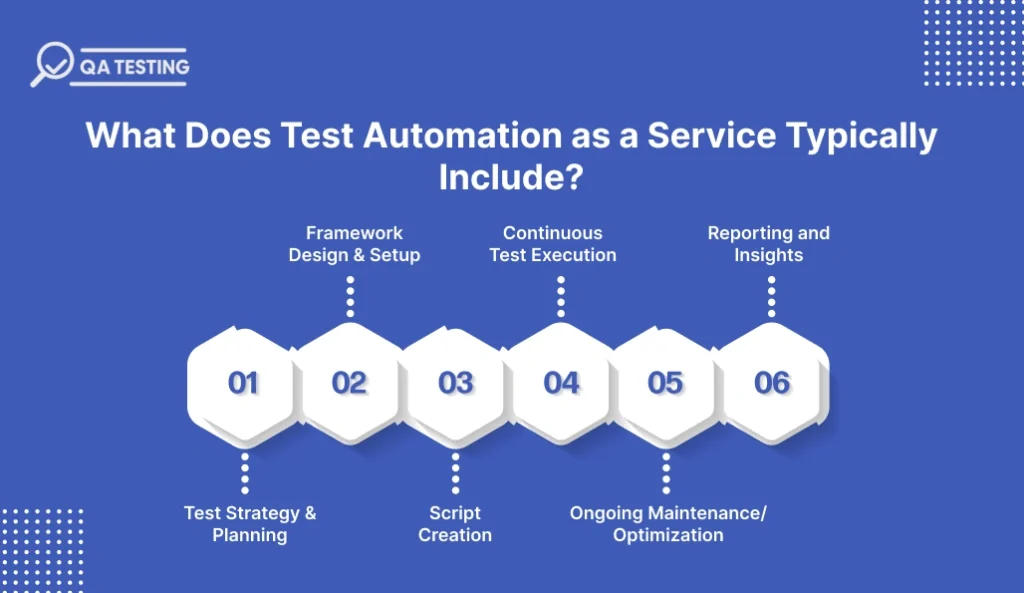
A full Test Automation-as-a-Service solution not only offers you the ability to run your automated scripts; it also supports you with automation solutions throughout the entire life cycle. This includes strategic planning and development of frameworks, the writing of your test scripts, executing through Continuous Integration, maintaining your automated test scripts, and having comprehensive reporting that supports you in achieving consistently high-quality, repeatable, and scalable results for faster release cycles.
- Test Strategy & Planning: The automation plan is created by looking at how your app works and what technology you’re using (both current and planned), along with what release cycle you’re following (both currently and planned). From there, the provider will develop their testing strategy around areas that have a potential risk, critical functionality (for your end users), and performance based on your application’s level of usage.
- Framework Design & Setup: TAaS squads create automation frameworks that are scalable, maintainable, and long-lasting by using tools such as Selenium, Playwright, Cypress, or Appium. The frameworks are made such that they can be used for the future as your product grows.
- Script Creation: Automation testers will write an ocean of reusable test cases for functional, regression (including API & UI testing), and performance tests according to your requirements.
- Continuous Test Execution: Testing continues to be an integral component of both CI and CD, so that with every build/deployment, tests are run automatically; therefore, defects will not reach production because they will have been validated before deployment.
- Ongoing Maintenance/Optimization: Applications are constantly evolving, and so are the corresponding test cases. Test Automation as a Service (TAaS) vendors often keep the test cases up to date with respect to new functionality or changes in the user interface.
- Reporting and Insights: TAAS solutions provide extensive dashboards, logs, and analytics for assisting teams with defect identification/tracking, risk identification, and overall release success.
Why Businesses Are Adopting Test Automation as a Service
The speed of software development is staggering in today’s environment. Due to increased release cycles, vague or undefined expectations for service delivery by users, and the need for rapid feedback, organizations can no longer depend on normal testing processes such as hand-testing alone. As a result, organizations are identifying a need to improve the speed of feedback, the breadth of coverage, and the level of accuracy. Because of this, more and more organizations are implementing Test Automation as a Service (TAaaS) to achieve these objectives.
By moving to TAaaS, organizations will be able to take advantage of a team of professionals with experience in test automation, advanced products, and scalable processes without having to invest the resources required to create an equivalent internal solution. Thus, organizations are able to meet analytics quality assurance requirements while still keeping up with established timeline commitments.
Businesses adopt TAaS to:
- Launch products faster by reducing testing bottlenecks
- Improve defect detection rates through automated and repeatable test runs
- Reduce repetitive manual testing, freeing QA teams for higher-value tasks
- Ensure consistent test coverage across features, devices, and platforms
- Support DevOps and continuous delivery with automated tests integrated into CI/CD pipelines
In short, Test Automation as a Service helps organizations deliver better software, more frequently, and with greater confidence.
Also Read: Best AI Testing Tools for Smarter Testing
Benefits of Test Automation as a Service (TAaS)
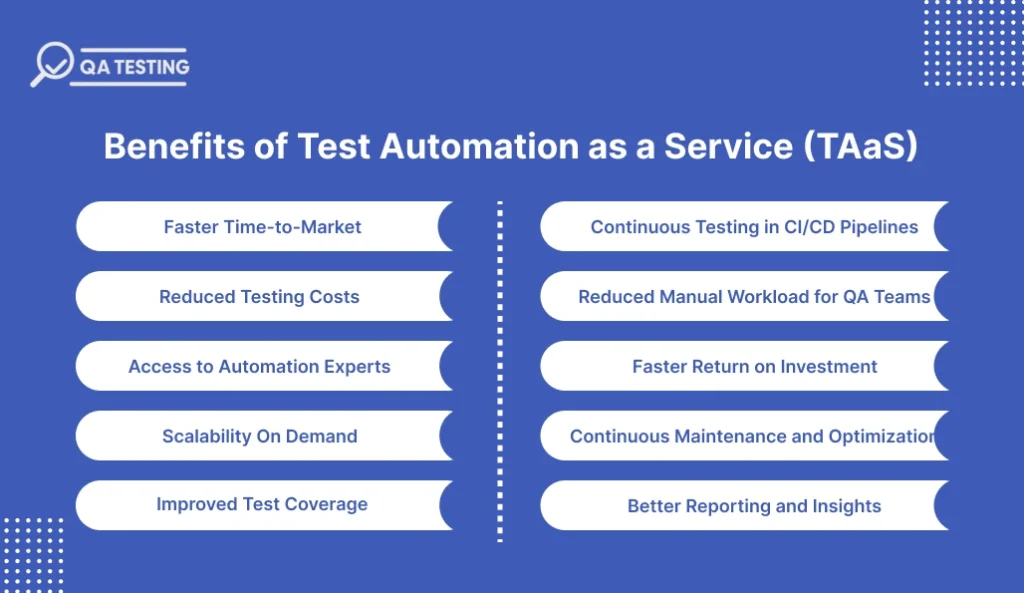
Adopting Test Automation as a Service (TAaS) gives organizations more than just automated test execution; it delivers speed, scalability, and expertise that are difficult to build internally. Here’s a deeper look at the key benefits.
1. Faster Time-to-Market
The automated test execution process via Test Automation as a Service (TaaS) will enable shorter testing cycles since automated test execution is much quicker than manually executing tests (i.e., executing the same test). TaaS providers have already created a framework, tooling, and environment for TaaS use, thus removing lengthy setups and allowing testers to begin the automated testing process more rapidly while still producing consistent results at an expected level of quality/efficiency.
This helps teams:
- Detect bugs earlier
- Reduce release delays
- Ship features more frequently
Faster testing directly supports agile development and continuous delivery.
2. Reduced Testing Costs
The establishment of an in-house automation team requires a large investment in recruitment, training, infrastructure, and testing tools. Test Automation as a Service turns a large upfront investment into predictable, service-based pricing and allows an organization to manage their budgets whilst continuing to access expert-level capabilities and access to skilled resources for testing at scale.
Organizations save money by:
- Avoiding recruitment and onboarding expenses
- Reducing tool licensing and maintenance costs
- Lowering long-term operational overhead
3. Access to Automation Experts
With Test Automation as a Service, companies have quick access to professional automation engineers with knowledge of current technology and the best practices for building the application. It can take an organization several years to hire the right staff, train them appropriately, and learn which tools are effective. Therefore, test automation as a service offers companies an effective and quicker solution for attaining high-quality automated testing capabilities.
These specialists:
- Design robust test strategies
- Build maintainable automation frameworks
- Ensure higher test accuracy and reliability
4. Scalability On Demand
Situations change often in projects, especially when it comes to launching products, rolling out new features, or making big updates. Using Test Automation as a Service (TaaS), companies have the ability to adjust testing resources for their projects as needed without incurring added expenses for hiring, training, or terminating internal QA employees.
This flexibility is ideal for:
- Seasonal traffic spikes
- Rapid product expansions
- Short-term high testing workloads
5. Improved Test Coverage
Testing manually takes up a considerable amount of time and also only typically tests a small part of the application. Test Automation provides a greater amount of test coverage and speed by validating the application on multiple devices, browsers, operating systems, and complicated user paths with much more consistency and efficiency.
Better coverage means:
- Fewer production defects
- More stable releases
- Higher customer satisfaction
6. Continuous Testing in CI/CD Pipelines
A continuous testing approach is provided by Test Automation as a Service through the integration of automated tests into CI/CD pipelines with every build or deployment. Automated test execution, which happens during those builds and deployments, ensures developers receive rapid feedback on the state of the application under test with respect to defects that may have been introduced during development, which in turn helps the team reduce integration problems and deliver stable, high-quality releases.
Benefits include:
- Early defect detection
- Faster debugging
- Reduced risk of release failures
7. Reduced Manual Workload for QA Teams
Internal QA teams can use Test Automation as a Service to handle their repetitive regression and functional testing needs while they spend their time on more valuable work, which includes exploratory testing, usability evaluation, and complex edge case research that requires human creativity and critical thinking skills.
This improves:
- Productivity
- Morale of QA teams
- Overall testing quality
8. Faster Return on Investment
Since Test Automation as a Service providers already have the necessary tools, infrastructure, and experienced professionals in place, organizations can realize benefits much faster than if they were to build an automation setup internally from the ground up.
The result is:
- Lower initial risk
- Quicker efficiency gains
- Long-term cost optimization
9. Continuous Maintenance and Optimization
Applications undergo continuous evolution because developers introduce new features, implement design changes, and work to enhance system performance. A Test Automation as a Service provider keeps automated test scripts synchronized with system modifications to maintain test accuracy, reliability, and testing effectiveness throughout software development.
This keeps automation:
- Reliable
- Stable
- Relevant over time
10. Better Reporting and Insights
Test Automation as a Service platforms provide detailed reports and real-time dashboards together with actionable analytics that enable teams to track defect patterns while they determine release readiness and test coverage, and complete testing evaluation for making data-based quality decisions.
These insights support:
- Data-driven decisions
- Better risk management
- Continuous quality improvement
Also Read: Why Beta Testing Is Critical in AI Tools Development
Cost-Benefit Analysis: Test Automation as a Service vs In-House Testing
The decision to establish an internal automation team or to implement Test Automation as a Service (TAaS) requires organizations to make a strategic financial commitment. In-house automation requires businesses to invest substantial capital while delivering benefits only after extended periods. The fixed expenses of TAaS convert into variable costs, which organizations can pay through service-based expenditure.
Let’s break it down.
Estimated Cost of In-House Test Automation
Establishing an effective internal automation capability means businesses must provide not only an adequate workforce of skilled workers, but also provide the necessary technology and logistical support required to implement it. In addition, companies should be looking to hire experienced automation engineers, supply them with ongoing training, purchase testing equipment (e.g., testing tools), and establish test areas. These support functions require a significant commitment of both financial resources and operational time and are long-term investments of the business.
| Cost Component | Typical Annual Estimate |
| 2–3 Automation Engineers Salaries | $90,000 – $180,000+ |
| Training & Skill Development | $3,000 – $8,000 |
| Automation Tools & Licenses | $5,000 – $20,000 |
| Test Infrastructure & Cloud Environments | $8,000 – $25,000 |
| Ongoing Script Maintenance Effort | $15,000 – $40,000 |
| Total Estimated Annual Cost | $120,000 – $270,000+ |
These costs increase as applications grow, platforms expand, and testing scope widens.
Estimated Cost of Test Automation as a Service (TAaS)
Test Automation as a Service providers deliver automated testing services through flexible subscription and project-based pricing models, which enable businesses to pay only for their required testing services while eliminating the need for expenses associated with full-time in-house testing teams.
| TAaS Engagement Type | Typical Cost Range |
| Small Project Automation | $2,000 – $5,000 per month |
| Mid-Sized Product Automation | $5,000 – $12,000 per month |
| Enterprise-Scale Automation | $12,000 – $25,000+ per month |
| Estimated Annual TAaS Cost | $24,000 – $150,000+ |
With TAaS, costs scale based on workload rather than fixed staffing expenses.
Side-by-Side Cost & Value Comparison
| Factor | In-House Automation | Test Automation as a Service |
| Initial Investment | High — hiring, tools, infrastructure | Low — provider already has setup |
| Annual Cost Stability | Fixed and high | Flexible and usage-based |
| Time to Start Automation | 3–6 months setup | Few weeks onboarding |
| Scalability | Limited by team size | Easily scalable on demand |
| Expertise Level | Depends on hiring success | Immediate access to specialists |
| Maintenance Responsibility | Internal team workload | Managed by TAaS provider |
| Risk of Staff Turnover | High impact | No dependency on single hires |
| ROI Timeline | Slower | Faster due to ready frameworks |
While in-house automation may exceed $120,000–$270,000 per year, Test Automation as a Service can deliver comparable or broader coverage for $24,000–$150,000 annually, depending on scope.
For startups, growing SaaS companies, and even enterprises seeking faster ROI and lower operational burden, Test Automation as a Service often provides the better financial and strategic choice.
Also Read: Best AI Testing Tools for Smarter Testing
When Should You Use Test Automation as a Service Instead of In-House Testing?
While in-house automation works well for some organizations, it isn’t always the most practical or cost-effective choice — especially when speed, flexibility, and expertise are critical. Test Automation as a Service (TAaS) becomes the better option in several common scenarios.
1. You Lack In-House Automation Expertise
Building effective automation requires specialized skills in tools, frameworks, scripting, and test architecture. If your team primarily has manual testing experience, developing strong automation capabilities can take months or even years. Test Automation as a Service gives you immediate access to experienced automation professionals without the learning curve.
2. You Need Fast Test Coverage for a New Product
When launching a new product or feature, time is everything. Setting up automation internally can delay releases while frameworks and scripts are being built. TAaS providers already have ready-to-use frameworks, allowing testing to begin quickly and helping you reach the market faster.
3. Your Release Cycles Are Frequent
Agile and DevOps environments often require weekly or even daily releases. Manual alone cannot keep up with this pace. Test Automation as a Service supports continuous testing by running automated test suites with every build, ensuring rapid feedback without slowing development.
4. Your QA Team Is Overloaded
Internal QA teams often spend too much time on repetitive regression testing. This limits their ability to focus on exploratory testing, usability improvements, and complex scenarios. TAaS offloads routine automation tasks, allowing your in-house testers to focus on higher-value quality activities.
5. You Need to Scale Testing Without Long-Term Hiring
Product demands fluctuate — especially during major updates, seasonal traffic spikes, or platform expansions. Hiring full-time automation engineers for short-term needs is inefficient. Test Automation as a Service lets you scale testing up or down as required, without the risks and costs of permanent staffing.
Test Automation as a Service is the ideal choice when your organization values flexibility, faster implementation, and cost efficiency. It allows you to strengthen your testing capabilities without the delays and overhead associated with building and maintaining an in-house automation team.
Industries That Benefit Most from Test Automation as a Service
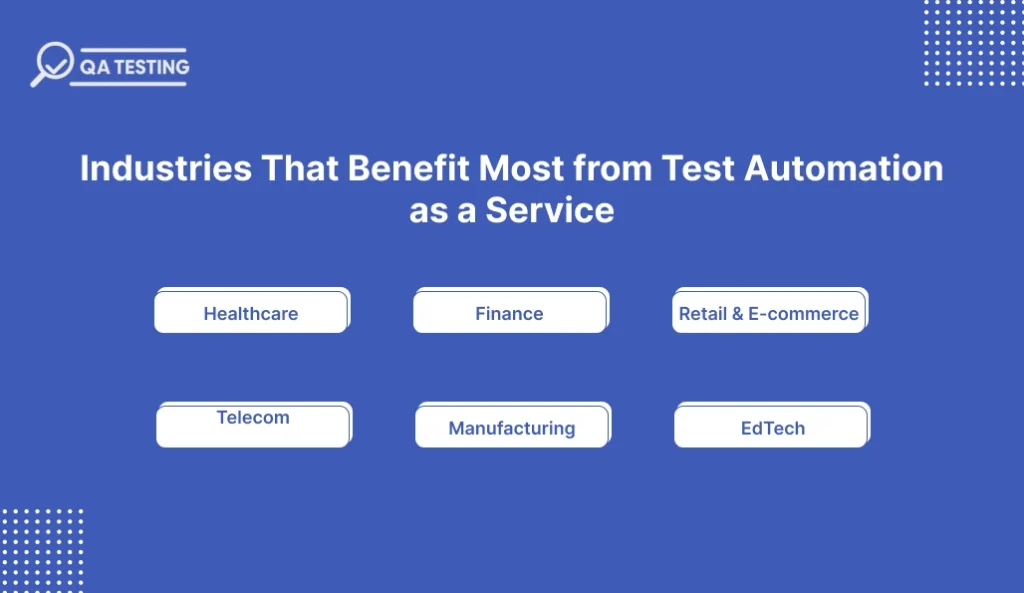
While Test Automation as a Service (TAaS) provides benefits to almost all industries, certain fields experience exceptional advantages because they require strict compliance measures and their operations develop complex systems, and their users maintain high service requirements. The following section demonstrates TAaS benefits through its applications in three different areas.
1. Healthcare
Health care systems must be fully reliable, secure, and compliant with existing data protection regulations. The health care system needs to operate continuously without any downtime or errors since all patient-facing systems, such as telemedicine software, electronic health records (EHRs), remote patient monitoring (RPM), and others, rely upon 24/7 functionality to maintain the safety of patients and protect their medical information while providing a seamless quality of care to patient populations.
Test Automation as a Service helps healthcare organizations:
- Ensure data security and privacy compliance
- Validate integrations between medical systems and devices
- Continuously test patient-facing applications for usability and reliability
- Reduce the risk of software errors that could impact patient care
2. Finance
Financial platforms handle delicate financial transactions together with private user information, while they need to achieve precise results through their ongoing operational work. The existence of minor software faults results in financial losses, together with security dangers and customer mistrust, as well as severe regulatory fines, which establish the need for dependable systems that undergo complete testing to support stable financial operations.
With Test Automation as a Service, financial institutions can:
- Test secure payment systems and digital wallets
- Validate mobile banking and online trading platforms
- Run frequent regression tests on fraud detection systems
- Ensure stability during peak transaction periods
Automation ensures accuracy, speed, and security across complex financial ecosystems.
3. Retail & E-commerce
Online retailers require their digital systems to function properly at all times, especially during peak periods, which occur during sales events and holiday times. Any checkout errors, together with slow page loads and payment failures, result in customers abandoning their purchases, which causes businesses to lose revenue while customers lose trust in the brand.
TAaS supports retail businesses by:
- Testing checkout flows and payment gateways
- Ensuring mobile and cross-browser compatibility
- Validating inventory, order management, and logistics systems
- Performing performance testing for peak traffic loads
This leads to smoother shopping experiences and fewer abandoned carts.
4. Telecom
Telecom systems enable network connectivity for billing systems, customer service websites, and operational management applications. The complex system needs to maintain its operational stability while handling maximum traffic conditions to provide continuous communication services and precise customer billing at all times.
Test Automation as a Service enables telecom providers to:
- Test network monitoring and service provisioning platforms
- Validate billing accuracy and subscription management systems
- Ensure customer self-service apps work seamlessly
- Maintain high performance across distributed systems
Automation ensures reliability at scale in this highly technical environment.
5. Manufacturing
Digital systems such as ERP applications, supply chain solutions, and IoT-enabled industrial machinery are critical for manufacturing organizations. When there is a software failure or performance issue, it can prevent manufacturing operations from occurring, delay shipments, and shut down whole production lines, resulting in expensive lost production due to downtime and reduced productivity overall.
TAaS benefits manufacturing by:
- Testing ERP and inventory systems for accuracy
- Validating IoT device integrations and data flows
- Ensuring production management software performs reliably
- Supporting digital transformation initiatives
This helps reduce downtime and maintain operational efficiency.
6. EdTech
The use of educational technology in live classrooms, streaming of video, online assessments, and collaborative tools creates sudden traffic spikes throughout the lifetime of the system (e.g., exam periods, course admission periods, etc.), which results in higher demand for stability, performance, and reliability to provide an uninterrupted learning experience.
With Test Automation as a Service, EdTech providers can:
- Ensure stable video streaming and virtual classroom tools
- Test learning management systems (LMS) across devices
- Validate online exam platforms for reliability and security
- Maintain performance during peak usage
Automation helps deliver uninterrupted learning experiences for students and educators.
Also Read: Quality Engineering vs Quality Assurance: Which Is Best?
Types of Testing Covered by Test Automation as a Service Providers
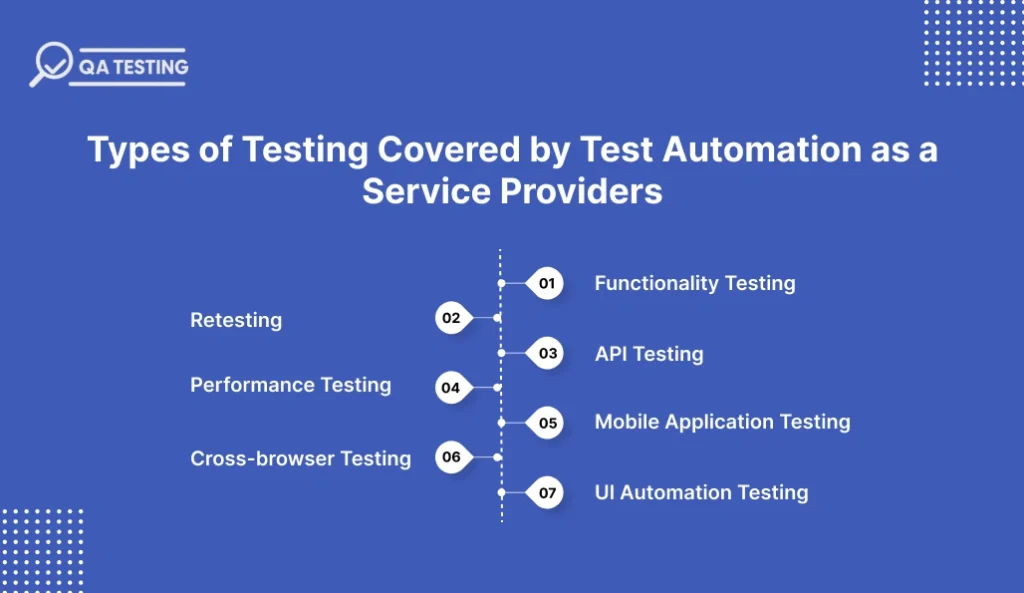
TAaS (Test Automation as a Service) is a provider that offers many automated testing solutions to provide application stability, security, and performance across multiple environments. TAaS usually provides a complete solution for quality assurance by supporting multiple types of testing rather than just one.
1. Functionality Testing
It guarantees that each feature within the app operates as intended. Automated functional testing provides validation of user activity, system reaction, and business logic across multiple workflows.
2. Retesting
When we release new features or make updates, we conduct regression testing to confirm that previous functions have retained their ability to perform correctly. TAaS service providers run automated regression suites regularly to identify potential unintentional issues quickly.
3. API Testing
APIs are at the center of how modern applications communicate with each other, and thus, TAaS teams’ platforms automate all API testing to ensure the proper transfer of data from one location to another, accuracy of responses received, proper error handling when results are received, and performance under load.
4. Performance Testing
Testing the performance of a given application will involve what is called user traffic on the application. TAaS service providers can emulate the real load conditions found in a typical working day, thus giving you an accurate measure of the performance of your application.
5. Mobile Application Testing
For mobile applications, TAaS services provide testing on all devices, screen sizes, and operating systems. The end result will be that your applications will work across both the Android and iOS platforms as intended.
6. Cross-browser Testing
Web applications are accessed and used through many different browsers and their many different versions. Automated cross-browser testing will give you the ability to ensure that your application operates and displays consistently on major web browser types such as Chrome, Firefox, Safari, Edge, and all other major browsers.
7. UI Automation Testing
UI automation will allow you to validate the various visual components of your application, verify the navigation features of your application, and validate the overall experience as it relates to your application’s user interface. UI automation also assures you that all of these items will continue to function as intended following your application being updated.
Frameworks & Tools Used in Test Automation as a Service
To provide scalable and dependable solutions for automation, providers of Test Automation as a Service rely on established tools and frameworks in their respective industries. With the help of these technologies, organizations are able to develop fully integrated test suites that can be easily managed within the framework of contemporary software development.
- Selenium: Selenium has grown to be one of the most commonly used tools for web browser automation. This free software tool allows users to automate even the most complex web applications, as it supports several programming languages.
- Cypress: Cypress is an open-source tool that’s gaining fast popularity as one of the quickest, growing web-based application automation tools. With Cypress, you can do tests really quickly thanks to its real-time test execution feature, which is why it’s ideal for testing the front-end components of web applications.
- Playwright: Playwright offers an all-in-one test solution that is compatible with every major web browser, and at the same time, it gives you extra tools to test modern web app features.
- Appium: Appium serves as the primary automation tool for mobile applications that run on both Android and iOS platforms. Appium enables you to conduct tests across different platforms by using a single testing framework, which lets developers create their tests one time for execution across various platforms.
- JMeter: JMeter serves as an essential tool for testing the performance of web applications that operate through internet connections. JMeter allows you to create a test environment with many users, which enables you to evaluate how your application performs and maintains stability during peak usage periods.
- TestNG: TestNG is a testing framework that enables testers to organize their test cases while creating detailed reports and controlling test execution through its integration with Selenium.
- Cucumber: Cucumber is a behavior-driven development (BDD) tool that enables testers to write their tests in plain, easy-to-read text and improves how well technical and non-technical team members work together.
Also Read: 10 Different QA Testing Types Explained: What You Must Know in 2026
How to Choose a Reliable Test Automation as a Service Vendor?
Selecting the right Test Automation as a Service (TAaS) provider is crucial for long-term product quality and testing success. The best testing partner implements assessments that help your organization enhance its quality assurance capabilities while establishing better trust in product launches.
Here are the key factors to consider when evaluating a TAaS provider:
1. Proven Experience in Your Industry
Every industry has unique compliance requirements, user expectations, and technical challenges. A vendor with relevant domain experience can understand your product faster and design more effective test strategies.
2. Strong Portfolio of Automation Projects
Look for case studies or past projects that demonstrate the provider’s ability to build scalable automation frameworks, handle complex systems, and deliver measurable results.
3. Transparent Pricing Models
Reliable TaaS providers will offer a transparent pricing structure, which means they will let you know what your costs will be before they begin. You should know precisely which services are included in your TaaS subscription and how scaling may affect the cost; you should also know how much support you can receive through TaaS.
4. Clear Communication and Reporting
Regular updates, detailed reports, and easy collaboration are essential. The vendor should provide dashboards, defect summaries, and release readiness insights that help your team make informed decisions.
5. Expertise in Modern Testing Tools
Your outsourcing partner must have experience with popular tools like Selenium, Playwright, Cypress, Appium, and performance testing platforms. Tool flexibility is key to making the right choice for your technology stack.
6. Ability to Integrate with CI/CD Pipelines
Automation should support your development workflow, not slow it down. A good TAaS partner integrates testing into CI/CD pipelines so tests run automatically with every build and deployment.
Conclusion
TAaS, or Test Automation as a Service, is a viable, strategic option that will take the operational burden of creating automation away from organizations looking to increase speed, decrease QA costs, and consistently produce high-quality software. TAaS can be utilized by businesses to gain access to scalable test automation along with the experience of automation engineers while providing seamless integration into Agile and DevOps methodologies. This allows for faster feedback cycles, fewer production defects, and ultimately allows teams to release with more confidence as a result of eliminating lengthy hiring timelines and the associated infrastructure costs.
If you are thinking about implementing TAaS, partnering with experts in this area can help make the process easier and more productive. Organizations such as QA Testing help their clients identify scalable, effective, and high-quality test automation solutions based on their unique business requirements and assist in accelerating the delivery of quality while increasing reliability.
In a digital landscape where speed and stability must go hand in hand, TAaS isn’t just an option anymore — it’s a strategic advantage.
Frequently Asked Questions
1) Does Test Automation as a Service (TAAS) benefit startups?
Yes, Test Automation as a Service provides startups with high-quality testing at an affordable price by providing quick access to experts, scalable resources, and shorter testing cycles as they continue to grow their products. Veteran start-ups can use Test Automation as a Service to deliver quality products quickly while utilizing their limited resources to develop new features.
2) What is the cost structure for Test Automation as a Service?
Most TAaS companies offer several pricing plans, such as subscription, project-based, or consumption. The costs of these plans are dependent on the size of the testing efforts, the level of difficulty, and the frequency of use. This flexibility allows you to carefully decide how much to spend on testing while scaling back or up based on the needs of your business.
3) Is Test Automation as a Service compatible with DevOps?
TAaS can fit seamlessly into a DevOps environment. By running automated tests on each build or deployment as part of your CI/CD pipeline, teams will receive immediate, real-time feedback on any defects and can therefore detect them earlier in the software development process. Additionally, continuous testing using automated tests will enhance the stability and reliability of your software, which is important for the continued success of any company.
4. Is data secure with Test Automation as a Service providers?
A reputable vendor will make sure that you are following all compliance standards for data security. They will also sign a non-disclosure agreement (NDA). Each test is conducted in a secure testing environment, where the vendor protects sensitive data using encryption, access controls, and strict data handling processes to safeguard both the client application and user data throughout the testing process.
5. Do I still need my own internal QA team if I use TAaaS?
Your internal quality assurance team is still crucial to the success of your overall project, even when using TAaaS. The internal QA team defines the test strategy, business requirements, and quality goals, while TAaaS is responsible for executing and scaling automated tests. Close collaboration between your QA team and the TAaaS provider ensures successful automation and maintains strong quality direction throughout the entire software development lifecycle.

Pankaj Arora
Founder, AppShopo

Pankaj Arora is a seasoned technology leader and the Founder of QA Testing, with over 10+ years of experience in delivering high-quality software testing solutions. He specializes in quality assurance strategy, automated testing, AI-driven validation, and performance optimization. Under his leadership, QA Testing has become a trusted partner for startups and enterprises, ensuring secure, reliable, and seamless quality assurance across web, mobile, and enterprise applications.