Agentic QA in 2026: The Complete Guide to AI Testing & QA
Software quality assurance is on the verge of a major change. Although traditional testing methods are still very useful, they often fall behind when it comes to dealing with rapid software releases, AI-generated code, and highly complicated applications. Industry reports show that software teams now deliver updates 208 times more often than under traditional development models, yet organizations allocate almost 30% of their development budgets for testing and quality assurance activities. But AI-assisted coding tools are speeding up software development, thereby increasing the demand for faster and smarter testing solutions.
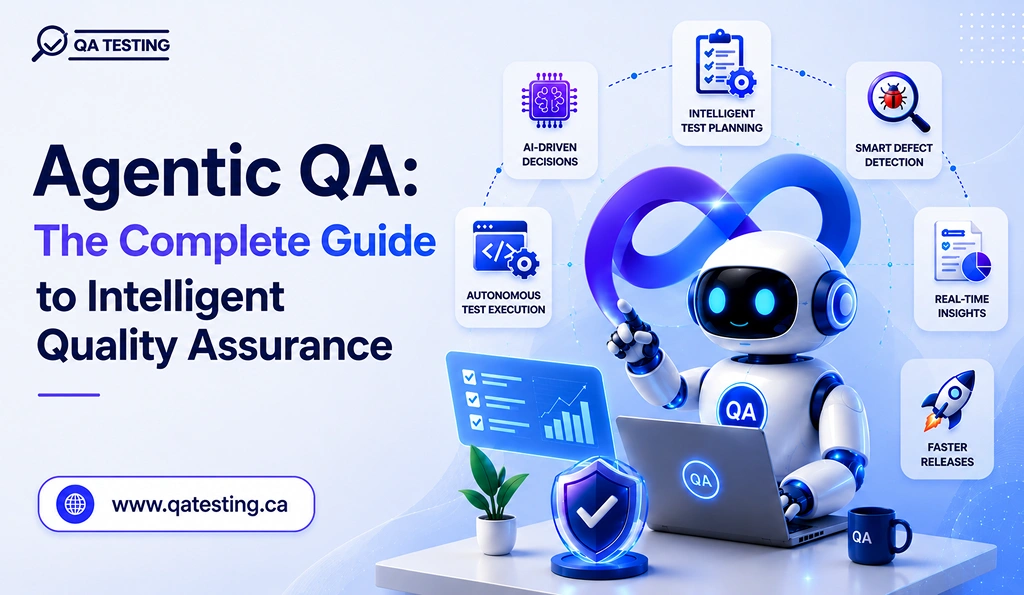
This need has resulted in the emergence of Agentic QA, which is a new method that combines artificial intelligence, autonomous decision-making, and intelligent automation to revolutionize software quality management. Versus traditional test automation that strictly executes scripts, Agentic QA uses autonomous AI agents that can comprehend requirements, create test cases, respond to application changes, and increase testing effectiveness over time.
By 2026, companies will be turning to Agentic QA to speed up their testing phases, decrease the amount of manual work, enhance test thoroughness, and produce better, top-quality software on a large scale. Industry experts believe that more than 80% of enterprises will embed AI-powered testing features into their software quality workflows by 2027, making intelligent testing an indispensable part of modern DevOps and continuous delivery methods. This guide covers everything about Agentic QA, like what it is, its advantages, features, examples, difficulties, and evolution.
TL;DR
- Agentic QA uses AI agents for autonomous software testing.
- Reduces manual testing effort and accelerates release cycles.
- Generates, executes, and maintains tests with minimal intervention.
- Improves test coverage through intelligent risk-based testing.
- Supports continuous quality assurance in modern DevOps environments.
Key Points
- Agentic QA fuses artificial intelligence, automation, and independent decision-making to produce more intelligent, rapid, and versatile testing methods.
- Unlike standard automation, Agentic QA is capable of understanding requirements, producing test cases, performing tests, and even fixing itself when errors occur.
- Companies deploy Agentic QA to raise software quality, cut down on maintenance spending, and speed up continuous delivery pipelines.
- Intelligent agents keep on learning from changes in the application, from past data, and from testing results to improve testing performance.
- With the rise of AI-driven development, Agentic QA is turning into an essential method for scalable, efficient quality QA that is ready for the future.
What Is Agentic QA?
Agentic QA is the use of AI agents that work independently to investigate requirements, make test cases, run the tests, find defects, react to application changes, and make the experiments better all the time with very little human help. Unlike traditional test automation, which is dependent on set scripts and unchangeable workflows, Agentic QA uses clever decision-making to meet test targets more quickly and accurately.
If we compare traditional automation to a machine that just does what it is told, Agentic QA is like a seasoned QA practitioner who knows business objectives, assesses risks, reacts to changes, and finds the most efficient way to check software quality.
Since software development cycle times are shortening and application functionalities are increasing, companies are adopting Agentic QA to improve their testing speed, scalability, and accuracy. Agentic QA, which is a combination of AI and autonomous problem-solving capabilities, is helping teams go beyond simple automation to intelligent quality engineering.
Key Technologies Behind Agentic QA
Agentic QA integrates several advanced technologies, including:
- Artificial Intelligence (AI)
- Machine Learning (ML)
- Autonomous AI Agents
- Natural Language Processing (NLP)
- Intelligent Test Automation
- Continuous Quality Engineering
All these technologies combined will help testing systems to be proactive rather than reactive. Agentic QA will not only run predefined test scripts but also find risks, generate new test cases, learn from past outcomes, and maintain a continuous improvement of software quality during the whole development cycle.
Also Read: Top 20 AI Testing Tools for Smarter Testing
How Agentic QA Works
The concept of Agentic QA revolves around an adaptive and learning-based feedback mechanism to guide an AI agent through software requirements analysis, test case generation, test case execution, and results validation and improvement. In essence, Agentic QA uses the test execution to make test case decisions and adapt tests as the application changes, unlike a conventional automation test case that will execute just the predefined test.
The process typically consists of four key stages:
1. Analyze Requirements
The first step in Agentic QA is understanding what needs to be tested. AI agents review various project artifacts to gain context about the application and its expected behavior.
These inputs may include:
- User stories
- Functional requirements
- Acceptance criteria
- API specifications
- Product documentation
- Business rules
By employing Natural Language Processing (NLP) and machine learning, the agent not only pinpoints the test requirements but also detects potential risks, critical user flows, and parts that are in need of more thorough validation. As a result, it assists in the prioritization of test activities based on business impact and the complexity of the application.
2. Generate Test Cases
After understanding the requirements, the AI system independently develops appropriate testing scenarios. Agentic QA is capable of producing extensive test coverage not only by creating test scripts manually but also through reflection of the application behavior and the risks that have been identified.
Common test types include:
- Functional testing
- Regression testing
- API testing
- Integration testing
- Edge-case scenarios
- Negative testing
This automated test generation process significantly reduces preparation time while increasing coverage across different user journeys and application conditions.
3. Execute and Monitor
Once the test cases are made, the agent rolls them out to different environments and keeps track of the results without interruption. The platform can confirm the working of an application, recognize failures, and gather performance data at the moment.
Typical testing capabilities include:
- Cross-browser testing
- Mobile application testing
- API validation
- User interface testing
- Performance monitoring
- Continuous integration testing
By continuously monitoring outcomes, Agentic QA quickly identifies defects, bottlenecks, and unexpected behaviors that could impact software quality.
4. Learn and Adapt
The killer feature in Agentic QA is the fact that it can learn from previous testing runs and reconfigure itself without being asked. Maintaining automation scripts is normally a time-intensive process as applications change. Agentic QA will overcome this by “smartly configuring” itself.
When application changes occur, AI agents can:
- Update existing test cases
- Repair broken test scripts
- Detect newly introduced risks
- Adjust testing priorities
- Generate additional test scenarios
- Improve future testing strategies
Such a continued learning mechanism enables Agentic QA systems to improve accuracy and effectiveness over time, thus lessening maintenance effort while consistently maintaining software quality during development.
The Continuous Feedback Loop
Agentic QA’s real power is that it can link all four stages into one ongoing feedback loop. Discoveries made in the execution and monitoring phases are used as inputs for requirements analysis and test generation.
So, testing progressively becomes more intelligent, adaptive, and in line with actual application behavior. This method refines itself over time so that companies can speed up software release, lessen manual work, and still deliver quality even in fast Agile and DevOps workflows.
Read Also: Beta Testing in AI Tools Development
Core Capabilities of Agentic QA
What really sets Agentic QA apart is its potential to rise above automation and become a “smart” testing partner. With this approach, organizations don’t just execute pre-scripted test flows; instead, they utilize smart AI agents that can grasp context, make autonomous decisions, and learn from their results, so the overall quality of software can keep evolving.
Through these powerful abilities, the testing cycle becomes much faster, and the scope of test coverage greatly expands without sacrificing quality, allowing for the quickest possible release of the product while minimizing human involvement.
1. Intelligent Requirement Analysis
Prior to testing, Agentic QA agents study business and technical requirements to figure out what to validate. With the help of Natural Language Processing (NLP) and AI, the system goes through user stories, acceptance criteria, product specifications, API documentation, and business rules to understand the testing objectives and reveal any possible risks.
Without relying on human testers to interpret requirements manually, the platform anticipates missing scenarios, vague requirements, and areas that might lead to quality risks at a later stage of the development cycle.
Benefits include:
- Early detection of requirement gaps
- Improved test planning accuracy
- Better alignment between testing and business goals
- Reduced risk of overlooked scenarios
2. Autonomous Test Generation
Agentic QA’s ability to generate test cases automatically is, without a doubt, its game-changing feature. It allows AI agents to draft exhaustive testing packages from the facets of requirements in the application, customer behavior, previously reported defects, and system use cases.
Workers are no longer required to devote a great deal of time to the manual scripting of tests with the help of AI-generated tests that address both standard and complex situations.
The system can automatically generate:
- Functional tests
- Regression tests
- API tests
- Integration tests
- End-to-end workflows
- Edge-case scenarios
- Negative test cases
This capability not only accelerates test creation but also significantly improves overall test coverage.
3. Self-Healing Test Automation
Conventional automated testing is usually quite brittle. Even a slight alteration to a button label, UI element, or the overall page layout might lead to numerous test scripts failing. The upkeep of these scripts demands a lot of QA personnel time and hinders the pace of development.
Agentic QA addresses this problem by implementing self-healing automation. The AI agents, when the application is changed, effortlessly find out what has been changed, look for other locators or ways of doing the work, and fix the broken tests without human help.
This results in:
- Reduced maintenance costs
- More stable test execution
- Faster adaptation to software changes
- Higher reliability of automation suites
Self-healing capabilities allow testing teams to focus on quality improvement rather than script maintenance.
4. Intelligent Failure Analysis
Software defects are not the only reasons for test failures. In fact, a lot of discoloration can be attributed to environmental factors, the instability of the test data, network issues, or a hiccup of the systems that were running temporarily.
Agentic QA works with AI-based root cause analysis to find out the reasons behind the test failure and classify the problem properly.
The platform can identify whether a failure is caused by:
- A genuine application defect
- Test script instability
- Environment configuration issues
- Infrastructure failures
- Third-party integration problems
- Data-related inconsistencies
By automatically classifying failures, QA teams spend less time investigating false positives and more time addressing critical quality issues.
5. Risk-Based Test Prioritization
Modern software is tested with thousands of test cases, which makes it impossible to run all the tests in a release cycle. Agentic QA performs an intelligent and risk-based prioritization of testing to focus the testing efforts on the areas that are of the highest risk to the user and business operation.
AI agents evaluate multiple factors, including:
- Business criticality
- Recent code changes
- Historical defect trends
- User traffic patterns
- Feature complexity
- Production incidents
This risk-driven approach ensures that the most important functionalities receive the highest level of testing attention before deployment.
6. Continuous Learning and Optimization
Unlike traditional automation tools, which are passive and do not change over time, Agentic QA is dynamic and evolves based on test actions and the way the application behaves.
Each test run, defect detection, problem found in production, and user engagement serves as training data for the AI system. As the platform accumulates such data, it enhances its ability to make better decisions and improve its effectiveness in testing.
Continuous learning enables the system to:
- Refine testing strategies
- Improve defect prediction accuracy
- Optimize test execution priorities
- Generate smarter test cases
- Adapt to changing application behavior
As the system gains experience, testing becomes increasingly efficient and intelligent.
7. Predictive Defect Detection
Smart Agentic QA systems can spot possible threats or problems that might turn into issues in the production environment. For example, by reviewing old test data, developer working patterns, and application changes, AI agents could guess which parts of the software are most error-prone.
This proactive approach helps organizations:
- Detect risks earlier
- Reduce costly production failures
- Improve release confidence
- Strengthen software reliability
Predictive quality insights allow teams to prevent problems rather than simply react to them.
8. Continuous Quality Monitoring
Quality assurance is not limited to the development cycle anymore. Agentic QA overcomes development environments by performing constant monitoring of the software behavior and user experience within the production system.
By integrating with CI/CD pipelines, monitoring tools, and analytics platforms, AI agents can:
- Detect quality degradation
- Monitor application stability
- Identify emerging risks
- Trigger additional testing when needed
- Generate actionable quality insights
This creates a continuous feedback loop that supports ongoing software improvement.
Agentic QA vs Traditional QA
Given the speed and sophistication with which we develop software, the quality assurance methodology, in its classic form, cannot effectively keep up with the modern release cycle. Classic QA is characterized by a great deal of human involvement, automation scripts designed for specific purposes, and the use of human intelligence and decisions. Agentic QA uses smart AI agents to automatically learn, adapt, optimize, and perform tasks in the QA process.
In essence, Agentic QA carries out a fundamentally different testing process. Where classic QA consists of predefined tasks to perform, agentic QA aims to reach quality goals.
| Feature | Traditional QA | Agentic QA |
| Test Creation | Primarily manual and time-consuming | AI-generated and automated |
| Test Maintenance | Requires continuous human updates | Self-healing and adaptive |
| Decision Making | Human-driven | AI-assisted and autonomous |
| Adaptability | Limited response to application changes | Dynamically adapts to changes |
| Test Coverage | Moderate and often constrained by resources | Extensive and continuously expanding |
| Failure Analysis | Manual investigation required | Automated root-cause analysis |
| Scalability | Dependent on team size and resources | Highly scalable across environments |
| Continuous Learning | No learning capabilities | Learns and improves over time |
| Risk Assessment | Manual prioritization | AI-powered risk-based testing |
| Execution Speed | Slower due to manual intervention | Faster through intelligent automation |
Benefits of Agentic QA
Trying to deliver software faster and at the same time keeping the quality high might be a struggle for traditional testing methods. Agentic QA solves these problems by using artificial intelligence, making decisions on its own, and learning continuously, so building a testing ecosystem that is smarter and more efficient.
Decreasing the human work and at the same time making testing more precise, Agentic QA can help companies shorten their development cycles, make the best use of their resources, and put on the market more reliable software. These points highlight the greatest benefits of employing Agentic QA.
Faster Testing Cycles
Agentic QA stands out first and foremost because it can speed up the software testing process remarkably. The fully automated AI agents are capable of requirement analysis, test case generation, test execution, and result interpretation, all autonomously and with minimal human intervention. This not only cuts down the hours dedicated to monotonous testing tasks but also allows companies to keep up with agile development cycles, continuous integration, and regular software releases while still upholding the quality norms.
Higher Test Coverage
Agentic QA contributes to substantial improvement in test coverage through the generation and execution of a wider variety of test scenarios than traditional testing methods. AI-enabled testing tools are capable of discovering edge cases, negative scenarios, and intricate user journeys that human testers might fail to notice. Studies on agentic testing structures have revealed significant enhancement in coverage and lessening of invalid or redundant test cases using continuous feedback and adaptive learning mechanisms.
Reduced Maintenance Costs
Keeping automated test suites working is arguably one of the most expensive parts of software testing for resources. Agentic QA came up with a solution to this problem by introducing self-healing functionalities that can autonomously adjust to application modifications, revise test scripts, and fix broken workflows. As a result, companies are able to minimize maintenance work, decrease operational expenditure, and enhance the longevity and success of their automation endeavors.
Better Defect Detection
Agentic QA is able to pinpoint defects in a more precise and effective manner than conventional testing methods by the use of artificial intelligence and continuous learning. Smart agents evaluate the operation of the application at various levels, which makes it possible for them to find the functional problems, integration breakdowns, regression errors, and issues with user experience. By adopting this method, teams are not only capable of finding the major problems at the earlier stages of the development process but also of minimizing the chances of defects making their way to the production environments.
Improved Productivity
Agentic QA enables QA engineers to move from mundane to strategic tasks. AI agents take up the burden of test creation, execution, maintenance, and failure analysis so that QA engineers can spend more time on exploratory testing, quality planning, risk assessment, and user experience analysis. This will increase the efficiency of QA teams and allow QA engineers to play a bigger role in improving the overall software quality.
Faster Time-to-Market
In highly competitive markets, a business needs to deliver software very quickly without any quality compromises. Agentic QA dramatically simplifies testing processes, minimizes obstacles, and speeds up the time-to-market readiness by constantly checking the quality of the application at various stages of the development cycle. So companies can have shorter software release cycles, unveil the new features faster, and satisfy the customer requests more promptly, all the while staying fully confident in the product reliability.
Also Read: Best Open Source AI Testing Tools for Scalable AI QA
Why Agentic QA Matters in 2026
The rapid adoption of Agentic QA in 2026 is mainly caused by various technological and business changes. On one hand, software development is accelerated, getting more complex, and gradually powered by AI. But conventional testing methods are incapable of following that pace. Companies are looking for smart testing solutions that are able to change, learn, and grow with contemporary development methods.
Faster Development Cycles
Thanks to modern Agile, DevOps, and CI/CD pipelines, organizations can now launch software updates several times a day. This fast pace of releasing new features is fantastic for innovation, but it also puts QA teams under a lot of pressure to quickly and accurately validate the changes.
Manual methods of testing can be the reason for the bottlenecks because these kinds of tests require human intervention, script maintenance, and repeated iterations. Agentic QA is an effective way to help in overcoming these challenges as it automates test production, running, and examination so that you can always be sure of the quality without stopping the developers.
Growth of AI-Generated Code
Using AI programming helpers on a large scale has quite a bit enhanced the pace of software development. Programmers are now able to produce code, resolve errors, and design new elements at a much higher speed than previously.
But rapid code production leads to more alterations in code that need to be verified. Conventional QA methods are not capable of managing this increasing amount of testing effectively. Agentic QA rises to this challenge by generating and modifying test cases autonomously. This way, the level of software quality is maintained alongside the rapid development brought about by AI.
Increasing Software Complexity
Modern applications are far more complex than traditional software systems. They often include:
- Cloud-native architectures
- Microservices
- APIs
- Mobile platforms
- Third-party integrations
- AI-powered features
Testing these interconnected systems manually can be time-consuming and error-prone. Agentic QA uses intelligent agents to understand dependencies, identify risks, and prioritize testing efforts, making it easier to manage complex application environments.
Demand for Continuous Quality
Testing just before the release is a thing of the past, and businesses can’t afford to rely on it anymore. Besides, today’s customers expect their applications to be accessible, safe, and efficient at any time. Then again, organizations have to meet their ever-increasing compliance and security requirements.
That means it’s imperative for enterprises to have uninterrupted insight into software quality at every step of the development process. Agentic QA helps with continuous testing and monitoring, which in turn enables developers to discover violations early, minimize risks, and ensure steady software quality.
Need for Smarter Testing Decisions
Traditional test automation is all about carrying out the scripted tests that were written beforehand. Though today’s software engineering entails smarter decision-making, apart from simple automation. Testing teams nowadays not only want to know what to test, but also when to test it and where the risks are most likely to be present.
Agentic quality assurance introduces smarts in the testing pipeline by understanding the necessities, assessing the degree of danger, assigning the highest priority to the most important test cases, and relentlessly improving the test strategies. Because of this, companies can devote their efforts only to the activities that bring them the highest value.
Enabling Scalable Quality Engineering
Applications are getting larger, and new versions are coming out more frequently, so simply hiring more people to do QA in the traditional way is not only crazy expensive but also not working anymore. Agentic QA allows companies to grow their testing teams thanks to AI agents, which can work independently and do very large amounts of testing activities even in different platforms and environments simultaneously.
So, quality assurance becomes faster, cheaper, and more capable of providing business support for a long time.
Agentic QA can radically change not only test execution but also decision-making learning, adaptation, and optimization by automating them. In doing so, quality assurance is no longer a reactive task but a proactive, intelligence-driven, quality engineering practice that not only meets but exceeds expectations.
How to Get Started with Agentic QA
Implementing Agentic QA shouldn’t be equated to throwing away your current testing setup and starting from scratch right away. Among the best organizations, a phased strategy is their go-to with the ability to not only help teams realize the advantages of agentic technologies but also keep disruption at minimum. Through the phased implementation of Agentic QA, companies can unlock the highest value, enhance the adoption, and gain trust in AI testing workflows.
Phase 1: Assess Your Current QA Maturity
Before you embark on getting agentic capabilities, it makes a lot of sense to examine your present testing setup first. Knowing how your organization operates at the moment will point out where Agentic QA can make the most significant difference.
Consider questions such as the following:
- What percentage of your test cases are automated?
- How much time is spent maintaining test scripts?
- Where do testing bottlenecks occur?
- Which testing activities consume the most resources?
- What are the biggest challenges affecting release speed and quality?
By assessing your current processes, you can establish clear goals and identify opportunities for improvement.
Phase 2: Start with a High-Impact Workflow
Rather than applying Agentic QA across the entire software development lifecycle immediately, begin with a single workflow where automation and intelligence can provide measurable value.
Regression testing is often the ideal starting point because it is:
- Repetitive
- Time-consuming
- High-volume
- Maintenance-intensive
In this arena, develop and deploy agentic features including automatic test creation, intelligent execution, and self-healing automation. Measure and communicate value by monitoring its impact on metrics like testing time, faults found, and ease of maintenance.
Phase 3: Expand Across the Testing Lifecycle
Once initial success has been achieved, gradually extend Agentic QA capabilities into other areas of the software quality process.
This may include:
- Requirement analysis
- Test planning
- Test case generation
- Risk assessment
- Failure analysis
- Production monitoring
- Continuous quality validation
Distinct agency functions lead to an empty earth if not wired together in an unbroken feedback loop. Data gained in execution and observer functions can promote planning of tests, predicting of risks, and strategies for quality assurance.
Phase 4: Evolve the Role of QA Teams
As AI agents begin handling repetitive and operational testing tasks, the responsibilities of QA professionals naturally shift toward higher-value activities.
Organizations should invest in developing skills such as the following:
- Test strategy development
- Risk analysis
- Exploratory testing
- Quality engineering
- Domain expertise
- AI governance
- Quality objective definition
Agentic QA can help to drive execution and decision support, but the quality goals still need human interpretation, understanding of business risk, and ensuring testing drives business intent.
Read Also: Top Automation Testing Companies
Challenges and Limitations of Agentic QA
While Agentic QA offers significant advantages, organizations must address several challenges to maximize its effectiveness.
1. Trust and Governance
Challenge: Organizations may hesitate to rely on autonomous AI agents without clear visibility into their decisions, test modifications, and risk assessments.
Solution: Implement governance frameworks, audit trails, and explainable AI capabilities to ensure transparency and accountability.
2. AI Hallucinations
Challenge: AI-generated tests can sometimes produce inaccurate, irrelevant, or invalid test scenarios.
Solution: Maintain human review processes and continuous feedback loops to validate critical test cases and improve AI accuracy.
3. Complex Business Logic
Challenge: AI agents may struggle to fully understand highly specialized business rules and industry-specific requirements.
Solution: Keep QA experts involved in requirement validation, exploratory testing, and strategic quality decisions.
4. Data Privacy and Security
Challenge: Testing systems often handle sensitive business and customer data, creating security and compliance concerns.
Solution: Apply strong security controls, data encryption, access management, and regulatory compliance practices.
5. Implementation Complexity
Challenge: Adopting Agentic QA may require investments in infrastructure, tool integration, and workforce training.
Solution: Start with a phased implementation approach, focusing on high-impact areas before expanding across the testing lifecycle.
6. Human Oversight
Challenge: Over-reliance on autonomous agents can lead to missed context and poor decision-making in critical situations.
Solution: Use a human-in-the-loop model where AI handles automation while humans oversee strategy, risk management, and final quality decisions.
By combining intelligent automation with proper governance and human expertise, organizations can overcome these challenges and successfully implement Agentic QA at scale.
Future of Agentic QA
Agentic QA is going to change the face of software testing, from a reactive activity to a proactive, intelligence-based discipline. As the AI technologies keep developing, Agentic QA will be the major facilitator for organizations to supply rapid, reliable, and higher-quality software.
Multi-Agent Testing Systems
The testing platforms of the future will rely on the collaboration of multiple AI agents working in tandem at different stages of the testing lifecycle. For instance, one group of agents will focus on requirement analysis, while others will handle test generation, execution defect analysis, and optimization, respectively. The integration of these different AI agents will lead to a more effective and harmonious testing environment.
Autonomous Quality Engineering
Quality assurance is projected to mature from testing alone into fully autonomous quality engineering. AI agents will keep an eye on, validate, and enhance software quality continuously with only very limited human touch.
Predictive Defect Detection
Instead of just recognizing problems, future Agentic QA systems tend to make use of recorded data, modifications in the code, and behavioral patterns to anticipate defects even before they materialize. Such proactive measures will aid teams in preventing issues in a timelier manner and mitigating risks linked to production.
Production-Aware Testing
Test plans and approaches are getting familiar with a lot of new information from the way people really use things and from production data. So, test QAs that work on their own will be making test cases and figuring out which ones to do first by studying how users engage with applications. Then, they will be able to focus on the most important scenarios.
Hyper-Personalized Quality Insights
Sophisticated AI will offer targeted, individualized recommendations to developers, testers, product managers, and business stakeholders, leveraging business objectives, release readiness, risk, and quality to make business-critical decisions at an accelerated pace.
As software complexity and release cycles grow, Agentic QA will become an integral part of software development practice, helping companies to drive continuous quality, improve efficiency, and gain a competitive edge.
Why Choose QA Testing for Agentic QA Solutions?
Organizations are increasingly using Agentic QA to improve the quality of their software while shortening delivery times, making it essential to select the correct testing partner. QA Testing has integrated extensive quality engineering knowledge with contemporary artificial intelligence-enabled testing services in order to assist organizations in establishing reliable, scalable, and business-driven Agentic QA initiatives.
Expertise in Modern Quality Engineering
QA Testing boasts extensive experience in software quality assurance, test automation, and quality engineering. Using established testing techniques along with Agentic QA processes, the team assists organizations in enhancing software reliability and simplifying testing processes.
AI-Powered Agentic QA Capabilities
With the recent trends and innovations in AI and automation, QA Testing enables its clients to embed Agentic QA solutions in their systems to enable self-generated automated test creation, self-healing automation, smart defect analysis, and persistent monitoring of quality.
Faster Releases with Continuous Testing
Quick and dependable software delivery is a prerequisite for contemporary development environments. Incorporating Agentic QA into the Agile, DevOps, and CI/CD pipelines, QA Testing makes continuous testing easier and shortens release cycles while ensuring that quality is not compromised.
Improved Test Coverage and Defect Detection
AI testing strategies are employed by QA Testing to help businesses find undetected defects, to ensure complicated user journeys are correctly tested, and to increase overall test coverage. In doing so this application remains stable, secure, and performs well over a range of devices.
Scalable and Cost-Effective Solutions
Whether you are a startup or a large corporation, QA Testing can provide Agentic QA solutions of any size. Through automated test execution, self-maintaining tests, and risk-based testing, you can reduce the operating cost and get high returns on your testing investment.
Strong Focus on Quality and Innovation
QA Testing always adjusts to new technologies and industry changes. By adopting Agentic QA, predictive testing, and autonomous quality engineering, the company supports businesses in outpacing competitors in the digital world.
End-to-End Testing Support
Providing end-to-end quality assurance services through the entire software development life cycle, from the requirement analysis and test planning to automation, performance testing, security testing, and production monitoring.
Partner for the Future of Agentic QA
QA Testing is a great way to get hold of Agentic QA help, and it is also a lead QA software testing team that leverages in-house technical strength, smart automation, and quality focus to help the company speed up innovation, minimize risk, and supply great digital experiences. As software testing is turning more and more AI-based, in the future, QA Testing is a tool to provide businesses with the comfort to change to Agentic QA.
By deciding on QA Testing, you do more than get a team with traditional quality assurance know-how; you get a team that also sees the future of Agentic QA, and this way helps keep your software not only reliable and scalable but also ready for the challenges of tomorrow.
Conclusion
Agentic QA is the new stage of software quality assurance. Instead of static scripts and manual tests, it utilizes intelligent AI agents to analyze requirements, generate tests, execute checks, locate defects, and evolve with an application.
With the rapid speed of development and the increasing complexity of the system, a company can’t always afford testing that must be designed around fixed scripts and manual execution. It has become crucial to ensure that testing can adapt to modern software at the pace of change through the use of autonomous reasoning, self-healing automation, intelligent defect analysis, and machine learning.
While human testing has a place in governance, strategy, and higher-level needs, Agentic QA allows QA teams to perform more critical and higher-value work by automating the time-consuming, repetitive elements of software testing. If a company wishes to release faster and attain better coverage and system reliability, it would do well to ensure that modern QA teams have a part to play in their system.
FAQs
1. What is Agentic QA?
Agentic QA is a software testing approach empowered by AI, leveraging autonomous agents for examining requirements, producing test cases, performing tests, detecting faults, and persistently adjusting to application modifications. It assists organizations in boosting software quality and at the same time, lessening manual testing work.
2. How is Agentic QA different from traditional test automation?
Traditional test automation depends on a series of scripts that have been previously written and human-managed workflows. Agentic QA does not just stop there; it uses smart AI agents that are able to decide, auto-generate tests, self-repair scripts that are no longer working, evaluate failures, and keep improving testing strategies automatically.
3. What are the main benefits of Agentic QA?
The main advantages of Agentic QA are reduced testing times, wider test scope, lowered maintenance effort, increased defect catching, improved team productivity, and the quickest possible software delivery. It will also enable you to have consistent quality assurance across different environments in your software development.
4. Can Agentic QA replace human testers?
Agentic QA is not intended to replace human testers but rather to make them more efficient. In reality, AI agents can handle the repetition of testing tasks; there are still areas for which QA professionals are indispensable. These areas include exploratory testing, business validation, quality strategy, risk assessment, and critical decision-making activities.
5. Is Agentic QA suitable for Agile and DevOps teams?
Absolutely! Agentic QA is a perfect fit for Agile and DevOps work settings. It merges effortlessly with CI/CD pipelines, allows for ongoing testing, quickens product launch intervals, and assists teams in keeping software quality at a high level while rolling out changes more often and in a more cost-effective manner.

Pankaj Arora
Founder, QA Testing

Pankaj Arora is a seasoned technology leader and the Founder of QA Testing, with over 10+ years of experience in delivering high-quality software testing solutions. He specializes in quality assurance strategy, automated testing, AI-driven validation, and performance optimization. Under his leadership, QA Testing has become a trusted partner for startups and enterprises, ensuring secure, reliable, and seamless quality assurance across web, mobile, and enterprise applications.