QA as a Service Guide: Types, Process, Benefits & Insights
High-quality software is extremely important in today’s constantly changing environment. Customers demand a seamless and stable system over any platform or device, and businesses are increasingly seeking quicker releases. As software evolves and the speed of development increases, more testing is required, and that’s where QA comes into its own.
The demand for software testing is constantly on the rise, with the market expected to reach $93.15 billion in 2033, with digital transformation, cloud, and agile being the driving forces. However, keeping a dedicated in-house QA team is costly and requires both financial and time resources, and significant expenditure of skilled people and test tools/infrastructure.
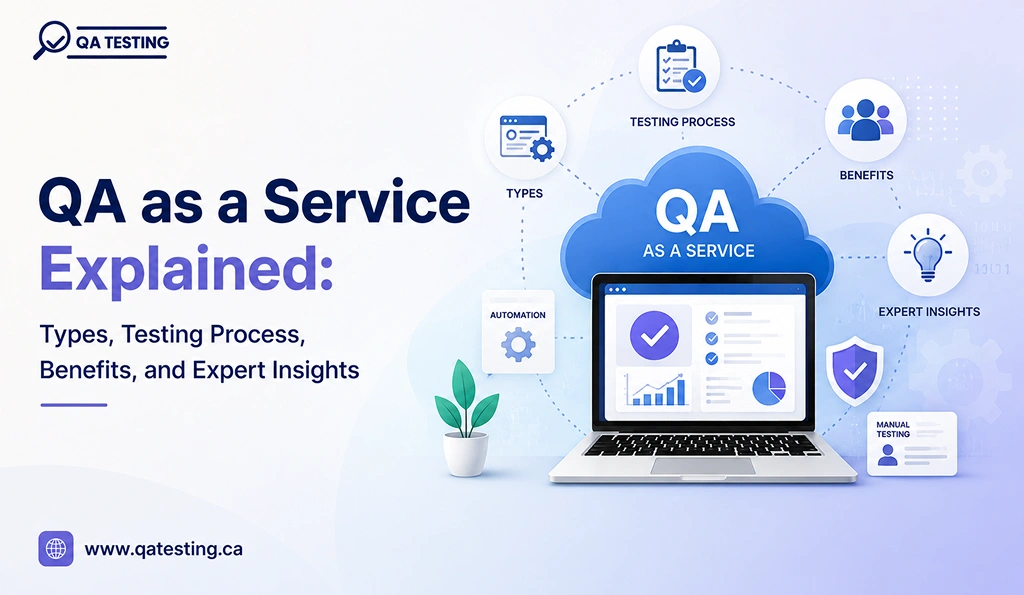
This is where QA as a Service (QAaaS) comes in. Outsourcing testing functions to specialist providers will give your organization the access it needs to skilled QA testers, cutting-edge tools, and flexible resources on demand. This guide explores the concept of QA as a Service, its different varieties, testing processes involved, benefits, and core recommendations for successful implementation.
TL;DR
- QA as a Service provides outsourced software testing expertise efficiently.
- Flexible testing resources help organizations scale quality assurance efforts.
- QAaaS improves software quality while reducing operational testing costs.
- Specialized testers accelerate releases through comprehensive testing strategies.
- Automation and continuous testing support faster, more reliable product delivery.
Key Points
- QA as a Service helps businesses leverage experienced testing capabilities without building large internal QA teams.
- Various QAaaS models, like functional, automation, performance, security, API, and mobile testing, are customized according to specific needs.
- A clear QA process, including requirement analysis, planning, execution, defect tracking, reporting, and continuous improvement, is followed.
- Benefits for an organization include reduced costs, reduced time to market, better quality, scalability, and new technologies.
- Success in QAaaS implementation requires clear goals, strong communication, integration from the start, automation, and performance measurement.
What Is QA as a Service?
QA as a Service is an organized method of software testing where a business outsources its quality assurance activities to testing professionals. In lieu of hiring, managing, and providing resources to an in-house quality assurance department, a business can integrate with a third party that has qualified testers, advanced testing technology, and tested methodologies to deliver software meeting the highest quality standards. This model of business will permit you to cover increased areas of your test cases as your needs increase and also allow you to reduce expenses by not having to pay for new staff, training, hardware, and general operations.
Due to the pace at which software is developed, quality assurance throughout the whole development process has to be the highest priority. With QA as a Service, you can detect problems, confirm functions, boost performance, and ensure the security of software by not allowing bugs to even reach the end-user. When tests are conducted throughout the entire development cycle, this helps prevent costly mistakes, ensures user satisfaction, and ensures speed in the development cycle.
Why QA as a Service Matters
- Ensures software quality without the expense of a dedicated in-house QA team.
- Provides immediate access to experienced testing professionals and specialized expertise.
- Supports Agile and DevOps environments with continuous testing practices.
- Helps detect bugs early, reducing development and maintenance costs.
- Improves application performance, security, and overall user experience.
- Enables faster release cycles and quicker time-to-market.
- Scales testing resources up or down based on project demands.
- Increases confidence in software reliability across devices and platforms.
From building an enterprise app to a mobile app, a SaaS or web app, QA as a service allows a scalable and efficient way to produce quality software with less expense. Using experts’ know-how, coupled with state-of-the-art tools and automation services, each release can become solid, secure, and available.
Also Read: System Integration Testing (SIT): A Complete Guide
Types of QA as a Service
The overarching service type within software testing is where all possible quality-related challenges are investigated. This type of testing service addresses customer quality expectations and enhances the experience based on specific business requirements and projects that a business undertakes.
1. Functional Testing Services
Functional Testing verifies that each and every functionality and feature of the application is behaving in the expected way based on the business and technical requirements. QA assesses user flow, input, output, and system responses for smooth operation and defect detection prior to production release.
Key areas covered include:
- User registration and authentication
- Login and account management systems
- Payment gateways and transaction processing
- Search and filtering functionality
- Form validation and data submission
- Business workflows and user journeys
Why it matters:
Functional testing ensures that end users can interact with the application without encountering errors, broken features, or unexpected behavior.
2. Automation Testing Services
Automation testing refers to using tools and test frameworks that can perform the test cases again and again automatically. Automation testing is beneficial for regression testing and CI/CD scenarios.
Key advantages include the following:
- Faster test execution
- Consistent and accurate test results
- Reduced manual testing effort
- Increased test coverage
- Rapid feedback for development teams
- Improved release efficiency
Why it matters:
Automation testing accelerates software delivery while maintaining quality standards, making it an essential component of modern Agile and DevOps workflows.
3. Performance Testing Services
Performance testing is a process that determines how an application is expected to perform under various workloads, user traffic, and operating environments. The goal of performance testing is to determine performance bottlenecks and identify optimal responsiveness, stability and scalability.
Common types of performance testing include:
- Load Testing
- Stress Testing
- Endurance Testing
- Scalability Testing
- Volume Testing
Why it matters:
Performance testing helps organizations deliver applications that remain fast, reliable, and stable even during peak traffic periods or heavy user activity.
Read Also: QA Testing: Key to High-Quality Software Solutions
4. Security Testing Services
The testing phase is about the identification of vulnerabilities that would lead to the disclosure of confidential data, the disruption of service, or the compromise of the integrity of the application. Security analysts examine applications, APIs, API, network and authentication systems to discover potential threats before the attacker is able to do so.
Areas commonly evaluated include:
- Data protection mechanisms
- User authentication security
- Access control and authorization systems
- Vulnerability assessments
- Penetration testing
- Regulatory and compliance requirements
Why it matters:
With cyber threats constantly evolving, security testing plays a critical role in protecting business data, maintaining customer trust, and ensuring compliance with industry regulations.
5. Mobile Application Testing
Mobile application testing aims at ensuring that applications provide an impeccable and fault-tolerant experience on multiple devices, operating systems, screen sizes, and network connections, and in a real-time context, it also validates functionalities, usage, and performance.
Testing areas typically include:
- Device and platform compatibility
- User interface responsiveness
- Application performance and speed
- Battery and resource consumption
- Network connectivity handling
- Overall user experience
Why it matters:
A well-tested mobile application improves customer satisfaction, reduces crashes, and ensures smooth performance across Android and iOS ecosystems.
6. API Testing Services
APIs provide the foundation for most modern applications, facilitating communication between systems, services, and third-party integrations. API testing ensures these integrations work as intended, securely and efficiently.
Key benefits include:
- Early detection of integration issues
- Improved system reliability
- Enhanced API security validation
- Faster troubleshooting and debugging
- Better application stability and performance
Why it matters:
API testing helps organizations ensure seamless data exchange, reliable integrations, and uninterrupted functionality across interconnected applications and services.
Choosing the appropriate mix of QA as a Service services will allow enterprises to manage their quality challenges preemptively, mitigate the associated risks, and deliver high-performing, secure software. Combining the above functional, automation, performance, security, mobile, and API testing services will provide an enterprise with the quality assurance necessary to build awesome digital experiences.
Also Check: Offshore Software Testing: Benefits, Challenges, & Insights
QA as a Service Process
Ensuring that you benefit as much as possible from a QA as a Service (QAaaS) project will mean that every part of the QA process must be structured, ordered, and controlled. Step-by-step application, right the way from understanding your requirements to post-release improvement, will ensure you are provided with the quality you deserve. In understanding what will happen at each stage, QA experts can preempt and identify bugs early, reducing your risk and the lifecycle of your product.
Step 1: Requirement Analysis
Initially, QA specialists study the business objectives, functional and technical requirements, as well as the acceptance criteria of the project.QA analysts meet with the stakeholders to fully understand the application and to identify any potential risks to quality.
Key activities include:
- Understanding business objectives and user expectations
- Reviewing functional and technical documentation
- Identifying testing requirements and priorities
- Assessing potential project risks
- Defining quality benchmarks and success criteria
Outcome: A clear testing roadmap aligned with business and project objectives.
Step 2: Test Planning
After the requirements have been analyzed, the QA team creates a thorough test strategy that defines how testing activities will be carried out during the project lifecycle.
The test plan typically includes:
- Scope and objectives of testing
- Testing methodologies and approaches
- Resource and timeline planning
- Test environment requirements
- Automation opportunities
- Risk mitigation strategies
- Reporting and communication procedures
Outcome: A structured plan that guides all testing activities and ensures efficient resource utilization.
Step 3: Test Case Design
In this stage, QA engineers develop extensive test cases and test scenarios using the application specifications and user interaction requirements. The test cases become the framework through which application functionality and performance can be validated.
Key activities include:
- Designing functional and non-functional test cases
- Creating positive and negative test scenarios
- Preparing test data and validation criteria
- Establishing traceability between requirements and test cases
Outcome: Comprehensive test coverage that ensures all critical features are evaluated.
Step 4: Test Environment Setup
The necessary environments were set up to resemble real-world production as much as possible before starting any testing. An accurate testing environment is important for catching bugs that may otherwise not be found until it’s too late.
Environment setup may include:
- Device and browser configurations
- Operating system compatibility setups
- Database configuration
- API integrations
- Network and server settings
- Test data preparation
Outcome: A stable and reliable environment for accurate testing results.
Step 5: Test Execution
The QA team performs manual and automated test cases based on the developed test strategy. While performing the tests, the application’s performance is compared with its expected behavior to pinpoint bugs, differences, and limitations.
Activities performed include:
- Functional testing
- Regression testing
- Automation test execution
- Performance validation
- Security verification
- Compatibility testing
Outcome: Identification and documentation of defects that require resolution before release.
Step 6: Defect Management
All identified issues are documented and tracked with issues assigned and prioritized according to severity, business impact, etc. Issues identified are worked on closely with, and bug fixes are verified.
Key defect management activities include:
- Defect logging and tracking
- Severity and priority assessment
- Collaboration with development teams
- Verification of bug fixes
- Retesting affected functionalities
- Regression validation
Outcome: Confirmed resolution of defects and improved software stability.
Step 7: Reporting and Analysis
After testing activities are completed, detailed reports provide stakeholders with valuable insights into application quality, testing progress, and release readiness.
Reports typically include:
- Test execution summary
- Test coverage analysis
- Defect trends and distribution
- Risk assessment findings
- Quality and performance metrics
- Release readiness evaluation
Outcome: Data-driven visibility into software quality and informed decision-making for deployment.
Step 8: Continuous Improvement
Quality assurance does not end after release. QAaaS providers continuously analyze testing outcomes, project performance, and lessons learned to enhance future testing efforts and optimize quality processes.
Continuous improvement focuses on:
- Enhancing test automation coverage
- Refining testing methodologies
- Improving defect prevention strategies
- Optimizing testing workflows
- Monitoring quality metrics over time
- Incorporating stakeholder feedback
Outcome: Ongoing improvements in testing efficiency, product quality, and overall development performance.
Also Read: QA Testing Guide: Process, Examples & Best Practices
Benefits of QA as a Service
With software systems constantly growing in complexity, delivering high-quality software within shortened release cycles has become an ever-present difficulty. Through the provision of skilled testing talent, innovative testing technologies, and adaptable resources to test software without the need to create and manage an in-house QA setup, QAaaS (Quality Assurance as a Service) allows you to gain all of the benefits of an internal QA department and beyond. The advantages it offers a business range from cost savings to increased time-to-market, all contributing to higher quality software.
1. Cost Efficiency
Having and managing an internal QA team means investment of money in hiring and training the resources, testing tools, infrastructure, etc. QAaaS removes this cost by providing the testing services as required, hence the business pays only for the services.
Benefits include:
- Lower operational and staffing costs
- Reduced investment in testing tools and infrastructure
- No long-term hiring commitments
- Better budget utilization and ROI
2. Access to Specialized Expertise
QAaaS providers bring together experienced testing professionals with expertise across various industries, technologies, and testing methodologies. Organizations gain immediate access to skilled specialists without the time and expense of recruitment.
Advantages include:
- Expertise in functional, automation, performance, and security testing
- Knowledge of industry standards and best practices
- Access to certified QA professionals
- Support for complex and specialized testing requirements
3. Faster Time-to-Market
In competitive markets, releasing software quickly can be a significant advantage. Dedicated QA teams streamline testing activities, identify defects early, and support continuous integration and delivery pipelines, enabling faster releases without compromising quality.
Key benefits include:
- Shorter testing cycles
- Faster bug identification and resolution
- Improved development efficiency
- Accelerated product launches and updates
4. Scalability and Flexibility
Project requirements often change throughout the development lifecycle. QAaaS allows organizations to easily scale testing resources up or down based on project demands, release schedules, and business priorities.
Benefits include:
- Flexible resource allocation
- Rapid adaptation to changing workloads
- Support for short-term and long-term projects
- Efficient handling of peak testing periods
5. Improved Software Quality
Comprehensive testing helps identify defects, usability issues, and performance bottlenecks before software reaches end users. Early defect detection reduces costly fixes and improves overall application reliability.
Quality improvements include:
- Enhanced application stability
- Better user experience and satisfaction
- Reduced production defects
- Increased software reliability and performance
6. Access to Advanced Testing Tools
Investing in enterprise-grade testing tools can be expensive for many organizations. QAaaS providers offer access to modern testing frameworks, automation platforms, device labs, and monitoring solutions as part of their services.
Organizations benefit from:
- Automated testing frameworks
- Performance and load testing tools
- Real-device testing environments
- Advanced reporting and analytics platforms
- Continuous testing capabilities
7. Reduced Business Risk
Software failures, security vulnerabilities, and performance issues can negatively impact customer trust and business operations. Thorough testing helps identify and address risks before deployment, reducing the likelihood of costly production incidents.
Risk reduction benefits include:
- Improved application security
- Better regulatory compliance
- Reduced downtime and service disruptions
- Lower risk of data breaches and system failures
- Increased confidence in software releases
Read Also: Test Automation as a Service (TAaS): Benefits & Costs
Challenges of QA as a Service and How to Overcome Them
Despite these many advantages, there can still be issues for an organization adopting a QAaaS approach in collaboration with external testers. Awareness of such issues and finding suitable solutions can increase a company’s chance of having an effective strategy.
1. Challenge: Communication and Collaboration Gaps
Remote testing teams (or teams that are distributed across time zones) may face communication challenges. Inaccuracies or lack of clarity around project scope, task priorities or defect reporting can significantly increase time and cost to a project.
Solution:
- Clearly define communication pathways and escalation points.
- Schedule frequent meetings and update sessions.
- Leverage communication and collaboration tools like Jira, Slack, and Microsoft Teams.
- Set expectations and assign clear responsibilities upfront.
Result: Improved transparency, faster issue resolution, and better alignment between development and QA teams.
2. Challenge: Limited Product and Domain Knowledge
External QA may not have an in-depth understanding of the application, business process flows, and domain-specific needs, and thus, test accuracy/coverage might be less in the initial stages of the project.
Solution:
- Do a full onboarding/knowledge transfer.
- Share thorough product specifications and documentation.
- Include QA in the design process and in requirement gathering.
- Have a readily accessible knowledge base.
Result: Better understanding of business objectives, more effective testing, and improved defect detection.
3. Challenge: Data Security and Compliance Risks
Entities entrusted with sensitive client, financial, or business information may have security fears when dealing with third-party testers, as a security breach or non-compliance could be detrimental.
Solution:
- Partner with providers that follow recognized security standards.
- Implement strict access controls and data protection policies.
- Sign Non-Disclosure Agreements (NDAs) and confidentiality agreements.
- Ensure compliance with relevant industry regulations and standards.
Result: Enhanced data protection, reduced security risks, and stronger regulatory compliance.
4. Challenge: Integration with Existing Development Processes
The integration of an external QA team needs to occur flawlessly with the organization’s current processes, such as the use of Agile, Scrum, DevOps, or Waterfall methods. A bad integration will cause a bottleneck in the project.
Solution:
- Match the QA process with the organization’s development model.
- Test actions should be implemented within the CI/CD pipeline and sprint activities.
- Make tools, reporting format, and procedures consistent.
- Ensure a cooperative relationship between developers and testers.
Result: Smoother workflows, faster feedback cycles, and improved release efficiency.
5. Challenge: Maintaining Consistent Quality Standards
Disparities in interpretations between teams regarding quality requirements, testing priorities, and acceptance criteria may exist, thereby compromising the consistency of testing results.
Solution:
- Develop measurable quality goals and testing requirements.
- Implement meaningful Key Performance Indicators (KPIs) and measures.
- Perform regular quality audits and reviews.
- Use a traceable set of tests and documented records.
Result: Consistent testing practices, improved software quality, and better project outcomes.
6. Challenge: Scaling Resources During Peak Demand
Project requirements can evolve very rapidly. Consequently, during significant releases and high development periods, additional testing resources may need to be allocated. If insufficient capacity is available, this can impact testing and delivery times.
Solution:
- Choose a QAaaS provider with scalable resource capabilities.
- Plan resource allocation based on project roadmaps.
- Utilize automation testing to reduce manual workload.
- Maintain flexible engagement models for changing needs.
Result: Faster adaptation to workload fluctuations and uninterrupted testing support.
Also Check: Regression Testing Guide in Software Quality Assurance
Expert Insights for Successful QAaaS Adoption
No question adopting a QA as a Service (QAaaS) model can improve quality and accelerate development. But if it is to provide the most benefits, it must be initiated correctly. As the experts will all state, the company must view this quality initiative as a true business initiative rather than merely a service for testing your software. Through proper goals and communication, there can be many improvements through QAaaS.
1. Define Clear Objectives from the Start
Before outsourcing testing, you will need to have determined testing objectives, quality standards, and deliverables. Having defined your objectives, you will be able to ensure the testing function is directed toward the business and project needs. Whether you are aiming for application performance improvement, a security upgrade, a reduction in test coverage, or faster release cycles, define specific and measurable objectives.
2. Prioritize Automation for Greater Efficiency
Still, increased software development agility and short iteration cycles often make manual testing a bottleneck for productivity and releases. Here, automation of regression and high-frequency test cases and tests that are of repetitive nature is advocated. Automated testing speeds up test execution but also enhances test repeatability and reliability. Automated structure also assists in the continuous execution of tests within the Agile and DevOps systems. Automation frees up valuable manual testing resources to explore more on usability and complex test scenarios.
3. Maintain Transparent Communication
Open communication will be extremely important for a smooth relationship with an in-house team and an outsourced QA firm. Through consistent meetings, clear status updates, and established lines of communication, both parties will always be up-to-date on where the team is with project goals, how the testing is progressing, and issues that arise. This type of communication will result in a more effective working relationship, faster decision-making, and more accountability, and will keep small issues from turning into much larger ones that can impact overall deadlines. Consistent communication can dramatically improve an organization’s outsourced QA relationship.
4. Monitor Key Quality Metrics
Monitoring and quantifying the performance of tests using relevant metrics will ensure that the quality of the software is known, and identify potential areas to be improved. It is very important to have consistent monitoring on parameters like Defect density, Test coverage, Automation coverage, Defect leakage, and Test execution time. This gives an idea about how well testing is performing, how stable the application is, and when it is ready for release. By continuously monitoring data, teams will know where to improve.
5. Integrate Testing Early in the Development Lifecycle
One quality assurance approach that has become extremely popular is ‘Shift-left,’ which, simply put, is the integration of QA activities in the initial phases of software development instead of waiting until all development is completed. Early QA activities find and resolve defects before they are exponentially higher in cost, improve team-worker relationships between testers and developers, increase validation of the requirements, and significantly reduce overall project risk. Quality assurance becomes part of the process rather than being integrated at the end.
6. Choose the Right QAaaS Partner
A critical success factor in any QAaaS engagement is undoubtedly the selection of the right testing partner. Companies should look into technical ability, domain knowledge, security protocols, communication style, scalability, and track record. A successful testing partner should not only possess sound testing skills but also an understanding of the client’s business needs and work practices. Clients can review client testimonials, case studies, and past successes to determine a testing partner that can provide lasting value.
Why Businesses Are Adopting QA as a Service
In this modern electronic age, in a competitive world, a business has to develop software-based products of high quality, dependable, safe, and usable across a spectrum of different devices, web browsers, and operating systems. Though achieving a high level of quality within time-restricted deadlines and ever-increasing customer expectations is not always so simple. The challenge of utilizing enormous testing teams with the appropriate resources, capabilities, and competencies, accelerating development complexity, and growing market roll-out requirements, many top companies look at QA as a Service (QAaaS).
QAaaS gives businesses experienced testing professionals, advanced testing tools, and flexible resources to meet project requirements. Outsourcing QA activities to a QAaaS provider allows businesses to focus more on business development and innovation, expedite product launches, and improve testing efficiency.
Key Reasons Businesses Choose QAaaS
- Access immediate testing knowledge: Leverage experienced QA professionals with specific testing know-how.
- Scalable testing resources: Ability to expand or contract test teams in accordance with release cycles and project needs.
- Shorter test cycles: Accelerate defect discovery and verification, enabling more frequent software releases.
- Increased software quality: Ensure the software meets all functionality, performance, security, and usability requirements.
- Lower operating costs: Eliminate expenses associated with significant hiring, training, and test infrastructure acquisition.
- Access to state-of-the-art testing tools: Employ state-of-the-art automation tools, performance testing tools, and testing environments.
- Risk mitigation: Address potential issues prior to release, thereby alleviating business and operating risks.
- Ability to support agile and DevOps methodologies: Support continuous testing and rapid feedback across development processes.
- Higher customer satisfaction: Deploy stable, functional, high-performance software applications, improving end-user experience.
- Concentrate on key business initiatives: Enabling internal teams to focus on product development and other key business activities.
With the accelerating digital transformation across various industries, QA as a Service has become a popular option for startups, SMBs, and even enterprise clients. Organizations are adopting QAaaS in view of the expertise it offers, the scalability, cost-effectiveness, and the dedicated focus on quality.
Read Also: Beta Testing in AI Tools Development – Importance & Risks
The Future of QA as a Service
The evolution of QA as a Service (QAaaS) is an accelerating trend fueled by innovation in technology and changes in how software is developed. The shift towards Agile, DevOps, and cloud-native systems has led to a growing need for better, faster, and more scalable testing solutions. Contemporary businesses need constant quality assurance to meet rapid release cycles and ensure software quality, performance, and security. To address this, QAaaS providers are incorporating cutting-edge technologies like AI, machine learning, and sophisticated automation to revolutionize software testing delivery.
1. AI-Powered Test Automation
With the help of artificial intelligence, software testing is evolving from manual execution of tests and simple automation scripts. It is changing how tests are written, run, and maintained. AI-driven tools allow intelligent generation of test cases based on application changes, identify high-risk areas within an application, and efficiently execute the tests to get quicker results. The usage of AI allows for a reduction in repetitive work and faster delivery of the software with good quality.
2. Continuous Testing in DevOps Environments
With the rise of DevOps as the common development practice, automated and continuous testing is evolving to be a central part of QAaaS. Since testing is part of the whole development process, development teams are gaining real-time response to their code modifications. Problems will be spotted earlier; both development teams and QA teams will communicate more efficiently, and consequently, there will be quicker and safer releases.
3. Cloud-Based Testing Environments
The cloud is providing scalability and flexibility in software testing never been seen before. Cloud-based test tools allow businesses to take advantage of many different devices, operating systems, browsers, and test environments without having to build up a prohibitive infrastructure. Full coverage of tests can be performed more cost-effectively and efficiently.
4. Predictive Quality Analytics
ML and sophisticated analytics. There is a clear shift among QA teams from a reactive testing approach to a quality management process that is more proactive. Predictive quality analytics can be used to analyze past test results to find trends and forecast likely future defects before they occur, enabling firms to reduce risks, focus resources, and make better development decisions.
5. Autonomous and Intelligent Testing Frameworks
QAaaS in the future will eventually be geared towards self-sustaining and self-adapting test automation systems that evolve as applications are constantly changing. Smart test systems are able to self-heal test scripts, prioritize tests, manage defects, and automatically optimize testing processes. Because they eliminate the need for manual effort, self-adapting and self-healing test systems are more accurate and can enable businesses to attain better overall performance and product quality for increasingly sophisticated application environments.
Over the coming years, QAaaS is expected to evolve as the underlying systems will become more intelligent, automated, and driven by data. Those business entities capable of making use of this emerging technology would likely gain a competitive edge with better performance, speed, and satisfaction levels, and can retain their competitiveness in the ever-evolving digital marketplace.
Why Choose QA Testing?
Today, in this highly competitive digital market, the quality of software affects the customer experience, business brand image, and also the growth. A small bug, performance issue, or security flaw can result in a negative experience of the users, loss of money, and loss of customer confidence. For these very reasons, businesses opt for QA testing in order to make sure that the software products reach the end user as secure, stable, and ready for use.
1. Experienced Quality Assurance Professionals
QA Testing gives you the advantage of working with experienced QA engineers, automation specialists, and testing professionals experienced in different domains and technologies. Leveraging their expertise aids in defect prevention, test efficiency, and end-to-end QA of the software development life cycle.
2. Comprehensive Testing Services
From functional and regression testing to performance, security, mobile, and automation testing, QA Testing offers end-to-end testing solutions tailored to project requirements. This comprehensive approach ensures every aspect of an application is thoroughly validated before release.
3. Faster Time-to-Market
By implementing efficient testing processes and advanced automation strategies, QA Testing helps organizations accelerate development cycles and release high-quality software faster. Early defect detection reduces delays and allows development teams to focus on innovation rather than fixing production issues.
4. Cost-Effective Quality Assurance
Building and maintaining an in-house QA team can require significant investments in hiring, training, infrastructure, and testing tools. QA Testing provides flexible and scalable testing solutions that help businesses reduce operational costs while maintaining exceptional quality standards.
5. Advanced Testing Tools and Technologies
QA Testing utilizes modern testing frameworks, automation tools, performance monitoring solutions, and real-device testing environments to deliver accurate and reliable testing results. Businesses benefit from enterprise-grade testing capabilities without additional infrastructure expenses.
6. Agile and DevOps Support
Modern software development requires continuous testing and rapid feedback. QA Testing seamlessly integrates with Agile and DevOps workflows, supporting continuous integration and continuous delivery (CI/CD) practices to improve development speed and software quality.
7. Improved Software Quality and User Experience
Through rigorous testing processes, QA Testing helps identify functionality issues, performance bottlenecks, usability concerns, and security vulnerabilities before software reaches users. This results in more stable applications, enhanced customer satisfaction, and stronger brand credibility.
8. Commitment to Client Success
QA Testing focuses on delivering customized testing strategies that align with each client’s business goals, technical requirements, and project timelines. Their collaborative approach ensures transparency, efficient communication, and measurable quality improvements throughout every engagement.
Conclusion
As software development becomes increasingly complex and fast-paced, maintaining consistent quality is essential for delivering reliable digital experiences. QA as a Service (QAaaS) offers organizations a flexible, scalable, and cost-effective way to ensure software quality without the challenges of managing a large in-house testing team. By leveraging specialized testing expertise, advanced tools, and proven methodologies, businesses can identify defects earlier, improve application performance, strengthen security, and accelerate release cycles.
From startups seeking affordable testing support to enterprises managing large-scale development projects, QAaaS provides the resources and expertise needed to adapt to evolving market demands. Its ability to support Agile and DevOps practices, scale testing efforts on demand, and improve overall product quality makes it a valuable solution for organizations focused on innovation and customer satisfaction.
As technology continues to evolve, investing in QA as a Service can help businesses reduce risks, optimize development processes, and deliver secure, high-performing software with confidence. Organizations that prioritize quality through a strategic QAaaS partnership will be better positioned to achieve long-term growth, enhance user experiences, and maintain a competitive advantage in the digital marketplace.
FAQs
1. What is QA as a Service (QAaaS)?
QA as a Service (QAaaS) is an outsourcing model in which organizations partner with specialized testing providers to perform quality assurance activities. These providers offer testing expertise, tools, and resources on demand to ensure software quality throughout the development lifecycle.
2. How is QAaaS different from an in-house QA team?
The primary difference is resource management. An in-house QA team is recruited, trained, and managed internally, whereas QAaaS provides access to external testing professionals and infrastructure as needed. This offers greater flexibility, scalability, and cost efficiency while reducing the burden of maintaining dedicated testing resources.
3. What types of testing are typically included in QAaaS?
Most QAaaS providers offer a comprehensive range of testing services, including functional testing, regression testing, automation testing, performance testing, security testing, API testing, mobile application testing, compatibility testing, and user acceptance testing (UAT). Services can be customized based on project requirements.
4. Is QA as a Service a good option for startups?
Yes. QAaaS is particularly beneficial for startups because it provides access to experienced testing professionals and advanced testing tools without the costs associated with building a full-time QA department. This allows startups to maintain high product quality while optimizing budgets and accelerating time-to-market.
5. How can businesses select the right QAaaS provider?
When evaluating a QAaaS provider, organizations should consider factors such as technical expertise, industry experience, testing methodologies, security and compliance standards, communication practices, scalability, client reviews, and proven project success. Choosing a provider that aligns with business goals and development processes is essential for achieving the best results.

Pankaj Arora
Founder, QA Testing

Pankaj Arora is a seasoned technology leader and the Founder of QA Testing, with over 10+ years of experience in delivering high-quality software testing solutions. He specializes in quality assurance strategy, automated testing, AI-driven validation, and performance optimization. Under his leadership, QA Testing has become a trusted partner for startups and enterprises, ensuring secure, reliable, and seamless quality assurance across web, mobile, and enterprise applications.