Offshore Software Testing: Advantages, Risks & Expert Insights
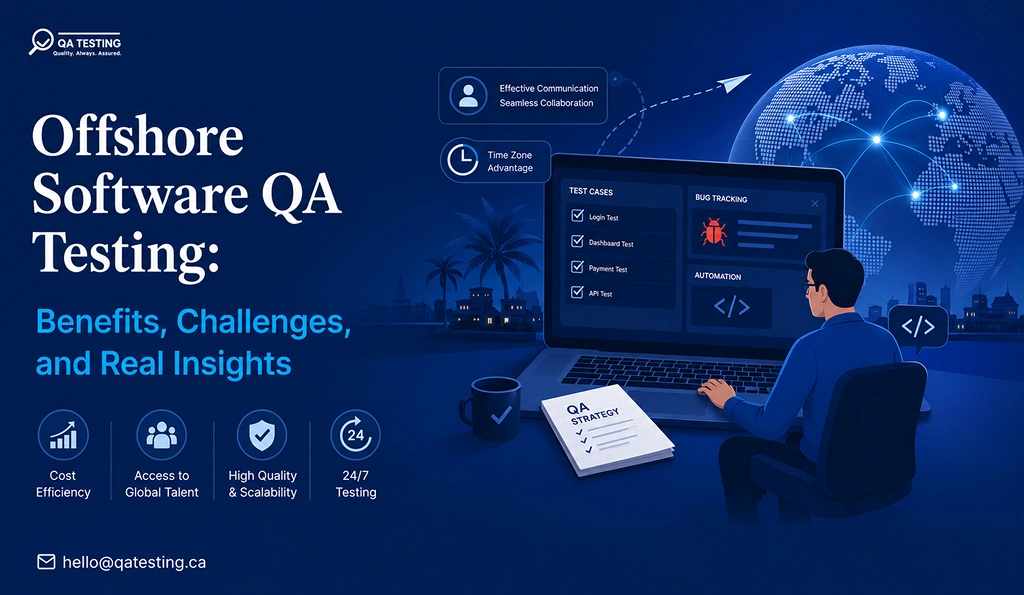
Offshore Software QA Testing is becoming a practical and business-wise decision for companies striving to enhance their software quality, speed up delivery time, and cut down development costs. The rapid pace of the digital market, coupled with short release cycles, makes it indispensable for businesses to utilize offshore QA teams that ensure their applications are stable and efficient and provide an optimal user experience across a wide array of devices.
From hyper-growth startups to mature enterprise businesses and those with vast software systems, all kinds of organizations can benefit from offshore software testing services, which offer them an abundant pool of specialized QA engineers, sophisticated automation technologies, and 24-hour coverage of tests. Yet, before turning to outsourcing their QA procedures, it’s crucial to be aware of the potential communication, operational, and management issues of offshore software testing.
In this blog, we discuss the practical advantages and disadvantages of Offshore Software QA Testing along with costs, approaches, and tendencies.
TL;DR
- Offshore QA testing reduces costs while improving software delivery speed.
- Global QA teams provide scalable testing expertise for growing applications.
- Automation testing strengthens product quality and accelerates release cycles significantly.
- Strong communication processes improve offshore software testing project collaboration success.
- Hybrid offshore QA models balance operational efficiency with local oversight.
Key Points
- Offshore Software QA Testing helps businesses reduce operational expenses while maintaining high software quality standards across multiple platforms.
- Offshore QA teams provide access to experienced automation engineers, security testers, and specialized quality assurance professionals globally.
- Businesses can accelerate product releases through continuous testing workflows supported by distributed offshore software testing operations worldwide.
- Effective offshore QA management requires strong communication systems, clear documentation, measurable KPIs, and structured collaboration processes.
- AI-driven automation, cloud testing, and hybrid QA models are reshaping the future of offshore software testing services.
Understanding Offshore Software QA Testing
Offshore software QA testing is the process of contracting your software testing and quality assurance needs to offshore or remote service providers located in a foreign country. Offshore QA companies provide and perform various software testing and QA activities for their clients. These activities include manual testing, automated testing, regression testing, performance testing, security testing, mobile testing, API testing, and other related services.
Offshore software testing aims to enhance the quality of the software applications being developed while lowering costs in the development process, maintenance, and operation of software applications. They work remotely in parallel to in-house development teams and are involved in performing various tests to ensure software quality, such as testing for performance, function, usability, and security standards.
Offshore testing is used extensively within a wide range of industries, including finance and banking (fintech), healthcare and medical industries, e-commerce, software-as-a-service (SaaS), supply chain management and logistics industries, the educational sector, enterprise software development, and a variety of other domains.
Also Read: Regression Testing Guide in Software Quality Assurance
Common Offshore QA Services
1. Functional Testing
Functional testing verifies whether the software application works according to defined business requirements and expected user behavior. Offshore QA teams test features, workflows, forms, navigation, and user interactions to ensure proper functionality.
2. Automation Testing
Automation testing uses scripts and testing frameworks to execute repetitive test cases efficiently. Offshore QA engineers build automated test suites that improve testing speed, reduce manual effort, and support continuous integration pipelines.
3. Mobile App Testing
Mobile app testing ensures applications perform smoothly across different smartphones, tablets, operating systems, screen resolutions, and network conditions. Offshore testers validate usability, responsiveness, and mobile performance.
4. Web Application Testing
Web application testing focuses on validating website functionality, design consistency, responsiveness, browser compatibility, and user experience across desktop and mobile environments.
5. API Testing
API testing validates communication between software systems and services. Offshore QA teams test API functionality, request handling, authentication, response accuracy, and integration stability.
6. Security Testing
Security testing aims to detect software vulnerabilities, data vulnerabilities, authentication weaknesses, and cybersecurity threats within application systems. By using security testers from overseas, they will support businesses in the overall application security and compliance.
7. Performance Testing
Performance testing analyzes the applications under varying workloads, bursts of traffic, and extreme pressure. The Quality Assurance team analyzes the application speed, scalability, response times, and robustness of the application.
8. Regression Testing
Regression testing ensures that the addition of new features, modification, or fix has not adversely affected the working of the application. Automation of regression testing is common among offshore QA teams for rapid releases.
9. Cross-Browser Testing
Cross-browser testing checks whether web applications function consistently across browsers such as Chrome, Firefox, Safari, and Edge while maintaining responsive design and user experience.
10. Cloud Testing
Cloud testing validates applications hosted on cloud infrastructure to ensure scalability, reliability, compatibility, and performance across distributed environments.
11. Accessibility Testing
Accessibility testing ensures applications remain usable for individuals with disabilities and comply with accessibility standards such as WCAG guidelines.
Also Check: Top Software Testing Companies in Canada
Building an Effective Offshore Software Testing Team
However, simply outsourcing QA functions does not amount to building a successful Offshore Software Testing team. Businesses are required to have an optimized Offshore Software Testing team structure and efficient team interaction, together with the appropriate technical abilities that sustain application quality all throughout the software development lifecycle.
An Offshore Software QA team seamlessly coordinates with developers, product managers, designers, and the DevOps engineers to produce an application that’s stable, secure, scalable, and convenient. Appropriate team structure leads the business in boosting test execution, quickening the time-to-release, decreasing defects in applications, and promoting enduring product stability.
Most successful Offshore Software QA Testing teams have a blend of these essential roles, but depend on project size, complexity of application, and the extent of automation that is deemed necessary.
Typical Offshore QA Team Structure
1. QA Manager
A QA Manager heads up the whole Offshore Software Testing process and acts as the communication point between the client and the offshore QA team. Their role encompasses specifying the test approaches, defining the schedule, allocating the resources, and maintaining the standards while ensuring the smooth flow of communications between teams. An effective QA Manager keeps testing consistent with business goals, the time schedule, and product requirements.
2. Test Automation Engineers
A Test Automation Engineer creates and maintains an automated testing framework, which leads to speedier, more consistent, and scalable tests. The engineer will also script repeatable test processes such as regression testing, smoke testing, and integration testing. These efforts would help the company to minimize the manual labor that has been incurred previously, have a speedier release, and support CI/CD pipelines.
3. Manual QA Testers
Manual QA testers are primarily concerned with the functional validation of the application. They carry out exploratory testing, Usability testing, Functional testing, and validation of workflows to find out bugs, interface anomalies, and user experience defects that automated tests are unable to find.
4. Performance Testers
Performance tests examine the application behavior at various load levels and traffic volumes. They assess the speed, scalability, response time, and application stability at maximum loads and usage levels. These tests assist organizations in maintaining the stable performance of their applications even with excessive numbers of users.
5. Security Testing Specialists
Security testers can spot loopholes, authentication weaknesses, data exposure issues, and security threats to the application. Security testers conduct penetration tests, vulnerability checks, and security validations to help businesses secure personal data and meet compliance requirements.
6. DevOps and QA Integration Specialists
DevOps and QA integration specialists are concerned with managing test environments, CI/CD pipeline integrations, automated deployment processes, and support of the cloud infrastructure. It helps to maintain testing procedures modern, automated, and synchronized with current agile practices.
Read Also: QA Testing Guide: Process, Examples & Best Practices
Popular Tools and Services Used in Offshore QA
Today, with the modern-day testing and QA tools, the offshore software testing team uses them for improving testing accuracy, speed, scalability, and collaboration of the whole testing process. Automation testing, performance monitoring, defect management, cloud testing, integration with CI/CD, and cross-browser and cross-device testing are all made possible using the same advanced technologies to deliver reliable, secure, and high-performance software across a range of devices and environments.
1. Automation Testing Tools
- Selenium
- Cypress
- Playwright
- Appium
- TestComplete
2. Performance Testing Tools
- JMeter
- LoadRunner
- Gatling
3. Bug Tracking and Collaboration Tools
- Jira
- Trello
- Azure DevOps
- Slack
- Asana
4. Cloud Testing Platforms
- BrowserStack
- Sauce Labs
- LambdaTest
5. CI/CD Tools
- Jenkins
- GitHub Actions
- GitLab CI/CD
- CircleCI
Advantages of Offshore Software Testing Services
The trend of outsourcing software testing services offshore has become a significant part of today’s software development approaches. Companies from all industries make use of offshore QA teams in order to ensure high product quality, minimize operational costs, get the products released faster, and obtain specialized knowledge of testing without a huge in-house QA department.
As the software becomes more complex and the release cycle time reduces, offshore software QA testing helps companies get the much-needed flexibility and scalability to ensure constant quality regardless of platforms, devices, or end-user scenarios.
1. Reduced Development Costs
Many companies are opting for Off-shore Software Testing Services mainly to reduce the cost. Having a QA team in-house can incur costs on training, infrastructure, salaries, and recruitment.
Offshore QA teams operating in regions with a less expensive labor force are capable of providing excellent quality software testing services for much lower charges. The companies are able to then invest much more into product development, advertising, and growth of the business while keeping quality on the higher side.
2. Access to Specialized QA Expertise
Offshore software testing providers may have a range of experienced QA members with knowledge of all kinds of testing environments. Teams may include, but are not limited to, automation engineers, performance testers, security testers, mobile QA testers, and cloud testers.
Numerous offshore software QA testing providers have the experience to use sophisticated testing frameworks, tools supported by AI for software testing, DevOps methods, and the compliance demands of your industry, and can bridge this gap to offer technical skill sets your organization may not have readily available.
3. Faster Product Releases
Modern software development relies on speed and constant delivery. Offshore testing teams spread across multiple time zones enable companies to work in an “always-on” mode and avoid bottlenecks.
When bugs are found, they are fixed in the earliest stages possible. It allows businesses to launch products quickly, thus improving their development process and speeding up market entry. The value of offshore QA is evident in Agile development and CI/CD practices where short development cycles and fast delivery are key.
4. Scalability and Flexibility
Offshore Software Testing Services allows companies to easily scale their QA resources with changing project scope, launch schedules, or seasonal demands.
Testing teams can be easily scaled up during product launches or scaled down once the application is released, without going through time-consuming hiring/termination procedures. This flexibility makes offshore QA a useful solution for startups and growing SaaS companies as well as for large enterprise development.
5. Better Test Coverage
In a full-time offshore QA team, tester will do their job only by testing, normally to cover a wider range of detailed tests. While a functioning test, regression test, compatibility test, performance test, security test, and user interface test can all be carried out by an offshore tester at the same time.
With the increase in test coverage, companies would develop fewer software bugs, get stable applications, and have a good user experience in different browsers/devices.
6. Access to Advanced Testing Infrastructure
Several offshore software QA testing service providers currently possess state-of-the-art testing infrastructure, such as cloud-based testing facilities, automated testing frameworks, device farms, virtual machines, and performance testing labs.
By utilizing the testing services of offshore testing partners, organizations are able to obtain enterprise-grade testing resources while refraining from extensive infrastructure investment at their own facility. Furthermore, offshore QA companies have knowledge of changing testing technology trends to support efficient quality assurance.
Offshore vs. Onshore Software Testing: Key Differences
Companies weigh up offshore versus onshore software testing models and finally choose the appropriate QA solution for their project. Although onshore testing is beneficial when easy communication and local coordination are key factors, offshore software QA testing seems more economical as it ensures cost saving, scalability, international talent, and the support of continuous testing.
| Factor | Offshore QA Testing | Onshore QA Testing |
| Cost | Lower operational cost | Higher cost |
| Talent Availability | Access to global talent | Limited local talent |
| Time Zone Coverage | 24/7 testing support | Limited working hours |
| Communication | May require structured processes | Easier direct communication |
| Scalability | Easier team expansion | Slower scaling |
| Compliance | Depends on vendor location | Easier local compliance |
Onshore QA may provide easier collaboration, but offshore software testing often offers better scalability and cost efficiency for growing businesses.
Choosing Between Offshore Testing and In-House QA
Whether to select in-house QA or offshore software testing depends upon various business factors, such as the nature and size of the project, budget,scalability needs, security issues and timeframes for software release. However, unlike in-house QA with direct involvement and internal monitoring, offshore software testing brings more cost benefits, readily available skills, quick scalability and steady testing support for evolving software development settings.
1. Offshore QA Is Ideal When:
- The business wants to reduce testing costs.
- The company requires rapid scalability.
- Internal QA resources are limited.
- Continuous testing support is needed.
- Specialized testing expertise is required.
2. In-House QA Is Better When:
- The project involves highly sensitive data.
- Constant in-person collaboration is essential.
- The organization operates under strict regulatory requirements.
- The product requires deep domain-specific knowledge.
Many companies now combine both models using hybrid offshore testing strategies.
Advantages of Offshore Software Testing Services
Offshore Software Testing Services have carved out a significant place for themselves in modern software development strategies. From quality enhancement, operational cost reduction, and faster product release to leveraging specialized testing expertise (without building massive in-house QA departments), businesses from different industries are employing offshore QA teams in large numbers.
As application complexity increases and software release cycles shrink, offshore software QA testing provides businesses with the agility and scale that is required to deliver consistent quality on varied platforms, devices and across user spaces.
1. Reduced Development Costs
One of the biggest reasons businesses adopt Offshore Software Testing Services is cost optimization. Hiring and maintaining an in-house QA department can be expensive due to salaries, infrastructure, training, recruitment, and operational overhead.
Offshore QA teams located in regions with lower labor costs can deliver high-quality software testing services at significantly lower rates. This allows businesses to allocate more resources toward product innovation, marketing, and business growth while maintaining strong software quality standards.
2. Access to Specialized QA Expertise
These offshore software testing firms usually employ mature and experienced QA engineers who possess a thorough understanding of various testing types. Typically, such a team includes automation engineers, performance testers, security experts, mobile QA engineers and cloud testers.
In addition, most of the Offshore Software QA Testing services vendors usually possess knowledge and experience of different modern test automation tools, AI based test frameworks, DevOps, security and compliances required in certain industries which are unavailable internally in the client company.
3. Faster Product Releases
Today’s software development is all about speed and delivery. Offshore teams that work across time zones assist enterprises achieve and keep the tests running constantly and speed up development.
By having defects discovered and fixed quickly, development companies speed up releases and improve their process of developing products. QA offshore support is great for environments like Agile or CI/CD where speed is crucial.
4. Scalability and Flexibility
Offshore Software Testing Services allows organizations to scale the QA resources to match the demands of the project, release schedule or any seasonality trends.
Companies can increase or decrease testing teams during major product launch, but scale down the testing resources once deployed, without going through slow hiring or restructuring process. This scalability offers great advantage for startups, increasing SaaS companies, enterprise development teams.
5. Better Test Coverage
Since the dedicated offshore QA team only deal with testing they have the time to provide more thorough and comprehensive test coverage. They are able to carry out functional tests, regression tests, compatibility tests, performance tests, security tests and usability tests at the same time.
The increased test coverage allows business to lower defect levels of the software, produce reliable applications and enhance customer experience on devices.
6. Access to Advanced Testing Infrastructure
Many Offshore Software QA Testing companies already maintain advanced testing infrastructure, including cloud-based testing environments, automation frameworks, device farms, virtual machines, and performance testing labs.
This allows businesses to access enterprise-level testing resources without making large infrastructure investments internally. Offshore QA providers also stay updated with evolving testing technologies, helping companies improve efficiency and maintain modern quality assurance practices.
Also Check: Top Software Testing Companies in Toronto
Selecting the Best Offshore Software Testing Company
The selection of the right Offshore Software Testing Company has a profound impact on the quality of the software, productivity of the project, project delivery timelines and ultimate business benefits. A trustworthy offshore QA partner is more than just a company executing test cases but it is actually a supplement to the in-house development team that helps to increase the product stability, minimize the software defects and enhance the releases.
As offshore software QA testing requires collaboration over the entire development cycles, vendors should be evaluated based on the technical expertise, communication protocols, scalability, security policies and industry experience prior to taking any decision.
Key Factors to Evaluate
1. Technical Expertise
First of all a business should consider the vendor’s technical knowledge. An Offshore Software Testing vendor should possess expertise in automation testing frameworks, mobile testing, cloud testing, API testing, security and performance testing, and CI/CD integration.
A technically competent company is capable of dealing with high-end applications, contemporary environments and future-proof testing demands.
2. Industry Experience
Experience in the particular industry is also critical. Off-shore QA providers that have worked on domains like healthcare, fintech, e-commerce, logistics, SaaS or education are more equipped to comply with industry regulations, understand customer requirements and typical operating processes.
For instance, healthcare apps may necessitate HIPAA compliance testing, while fin-tech platforms require rigorous security measures and transaction validation.
3. Communication Process
Effective communication is of paramount importance when it comes to working with an offshore vendor. While selecting the vendor, one must look at how the company conducts its meetings, the way in which progress is reported and monitored, and how it conducts its documentation and escalation of issues.
A well defined set of communication protocols enables minimize misunderstandings and ensure that all internal team members and the offshore team members are in alignment and working effectively together during the entire development lifecycle.
4. Security Standards
When outsourcing software testing, never compromise on security. The offshore vendor’s security certificates, NDA policies, data protection policies, access controls, and standards should be examined.
Trustworthy Offshore software QA testing companies use secure practices to protect your business data, customer data, and application infrastructure.
5. Scalability
The requirements in a business evolve while developing software. A reputable Offshore Software Testing Company will be adept in scaling QA resources as needed depending on factors such as project scale-up, release cadences, testing intensity or seasonal pressures.
A flexible offshore team scale-up can be done without the hassle of hiring or the long onboarding procedures
6. Client Reviews and Case Studies
Testimonials from existing clients, online reviews, and case studies of past successes all highlight a vendor’s reliability, communication clarity and delivery success.
Examining past outsourced QA experiences allows companies to see how a vendor tackles complex testing problems, works with clients, and achieves quality with regard to different industries and technologies.
Best Practices for Managing Offshore QA Teams
Effective offshore software QA testing is more than just possessing a set of testing and technical skills. The firm must set effective operations management practices to enable offshore QA to keep pace with development objectives, delivery timelines, quality requirements, and communication standards.
When offshore testing teams are well-managed, they increase team communication and testing efficiency, reduce project delays and help the business maintain software quality at every stage.
1. Define Clear Requirements
Well defined and detailed project requirement specification is a crucial factor to a successful offshore QA strategy. Companies must clearly define test cases, work processes, desired features, expected reporting methods, bug priorities, and acceptance criteria prior to test execution.
Clearly defined project specifications will avoid confusion, limit ambiguity, and improve offshore QA team’s test execution quality and speed.
2. Use Centralized Communication Tools
Open communication is a critical factor for offshore software testing. Enterprises must establish a common point of communication tools like Jira, Slack, Microsoft Teams, Trello or Azure DevOps to enhance visibility in a software testing process.
Through common point, a team can share information such as: updates, track issues, monitor the progresses and manage tests in a much efficient manner.
3. Establish QA Metrics
Tracking measurable QA performance indicators helps businesses evaluate offshore testing efficiency and software quality. Important metrics may include defect density, automation coverage, release stability, regression success rates, test execution speed, and escaped defects.
Defined KPIs improve accountability and support continuous QA process improvement.
4. Schedule Regular Meetings
Frequent sync meetings between development teams, project managers, and offshore QA engineers improve collaboration and project visibility. Regular discussions help clarify requirements, resolve blockers quickly, and ensure alignment throughout sprint cycles and release phases.
Consistent communication also strengthens trust between internal and offshore teams.
5. Prioritize Documentation
Well-documented QA processes improve testing consistency, onboarding efficiency, and long-term project management. Proper documentation should include test plans, automation frameworks, bug reporting guidelines, release notes, and workflow procedures.
Strong documentation becomes especially important when scaling Offshore Software QA Testing operations across multiple projects or distributed teams.
6. Integrate QA Into CI/CD Pipelines
Modern Offshore Software Testing works best when integrated directly into CI/CD pipelines and agile workflows. Continuous testing allows businesses to identify bugs earlier, improve deployment reliability, reduce manual effort, and accelerate software releases.
Automation and CI/CD integration also help offshore QA teams support faster development cycles without compromising software quality.
Evaluating Onsite and Offshore QA Collaboration Models
Many businesses now combine onsite and Offshore Software Testing teams to create a more balanced and efficient quality assurance strategy. This collaborative approach helps organizations improve communication, maintain project visibility, and accelerate software delivery while still benefiting from the scalability and cost advantages of offshore QA operations.
In the onsite-offshore model, onsite teams typically handle stakeholder coordination, business communication, strategic planning, and requirement management, while offshore QA teams focus on test execution, automation, regression testing, performance validation, and continuous quality assurance activities.
This hybrid collaboration structure allows businesses to maintain stronger operational control without sacrificing flexibility or scalability.
1. Better Stakeholder Communication
Onsite QA managers and coordinators can communicate directly with internal stakeholders, business teams, and product owners, helping reduce communication gaps and improving decision-making speed.
2. Faster Requirement Clarification
Having onsite resources available allows businesses to clarify technical requirements, feature updates, and project changes quickly before passing tasks to offshore testing teams.
3. Local Project Oversight
The onsite team provides direct supervision, project monitoring, quality control, and delivery management while ensuring offshore QA activities remain aligned with business goals.
4. Cost-Efficient Execution
Businesses can reduce operational costs by assigning large-scale testing, automation, and repetitive QA activities to offshore teams located in cost-effective regions.
5. Scalable Offshore Operations
Offshore Software Testing teams provide flexible resource scaling based on release schedules, product expansion, or increased testing workloads without requiring extensive internal hiring.
Real-World Examples of Offshore Software Testing Success
Many businesses across industries use Offshore Software Testing to improve software quality, accelerate release cycles, reduce operational costs, and strengthen application reliability. Real-world implementations show how offshore QA teams help organizations manage complex testing requirements while supporting rapid business growth and continuous product development.
1. Ecommerce Platform Scaling
An ecommerce company outsourced regression testing and automation testing to an Offshore Software Testing team during peak seasonal sales periods. The business needed faster feature releases, stable application performance, and continuous quality assurance support across web and mobile platforms.
The offshore QA team developed automated regression frameworks, expanded test coverage, and performed continuous compatibility testing across multiple devices and browsers. As a result, the company reduced release delays, minimized production bugs, improved checkout stability, and maintained better application performance during high-traffic sales campaigns.
2. SaaS Product Automation
A growing SaaS startup implemented Offshore Software QA Testing to reduce heavy manual testing workloads and improve deployment speed within its CI/CD environment. The company struggled with repetitive regression cycles that slowed feature releases and increased QA overhead.
The offshore automation engineers built scalable automated testing frameworks integrated directly into the deployment pipeline. This significantly reduced manual testing effort, accelerated release cycles, improved defect detection speed, and allowed the internal development team to focus more on product innovation and feature development.
3. Mobile Banking Application
A fintech company partnered with Offshore Software Testing specialists to strengthen mobile banking security and compliance testing. Because financial applications handle sensitive customer data and transactions, the company required advanced security validation and regulatory compliance support.
The offshore QA team conducted penetration testing, vulnerability assessments, API security validation, and compliance-focused testing procedures. This helped the company improve application security, reduce potential cybersecurity risks, strengthen transaction reliability, and maintain industry compliance standards while supporting continuous mobile application updates.
Hybrid Offshore QA Models Explained
Hybrid offshore software testing combines local project leadership with offshore execution teams.
Why Hybrid Models Are Growing
- Improved communication
- Reduced operational costs
- Faster delivery cycles
- Better quality control
- Stronger strategic oversight
Hybrid models help businesses balance cost efficiency with project visibility.
Why Offshore Software Testing Is Growing Globally
The global demand for offshore software QA testing continues to rise because modern businesses are under constant pressure to deliver high-quality applications faster than ever before. Customers expect stable, secure, fast, and bug-free digital experiences across mobile apps, websites, enterprise systems, cloud platforms, and connected devices.
Traditional in-house QA departments often struggle to keep pace with rapid release cycles, expanding technology stacks, and increasing testing complexity. Offshore software testing addresses these challenges by providing scalable engineering support, access to specialized testing expertise, and operational flexibility.
Key Business Drivers Behind Offshore QA Growth
1. Digital Transformation
Businesses undergoing digital transformation require extensive testing support for cloud migration, enterprise modernization, mobile applications, API ecosystems, AI integration, and automation platforms. Offshore Software Testing teams help organizations manage these large-scale testing requirements efficiently.
2. Agile and DevOps Adoption
Agile development and DevOps practices rely heavily on continuous testing and rapid release cycles. Offshore QA teams help businesses maintain continuous integration and continuous delivery workflows by supporting automated testing, regression testing, and ongoing release validation.
3. Global Product Expansion
Applications serving international users must function across multiple devices, operating systems, languages, and regional environments. Offshore Software QA Testing provides broader testing coverage for multilingual platforms, cross-browser compatibility, and region-specific user experiences.
4. Growing Automation Demand
Businesses increasingly depend on QA automation to improve testing speed, scalability, and deployment efficiency. Offshore QA providers often employ automation engineers experienced with Selenium, Cypress, Playwright, Appium, cloud testing frameworks, and CI/CD integration tools.
5. Rising Cybersecurity Concerns
As cyber threats continue to increase, security testing has become a critical part of software quality assurance. Offshore Software Testing teams now play a major role in vulnerability testing, penetration testing, API security validation, and compliance-focused QA processes.
6. Cost Optimization and Scalability
Companies also adopt Offshore Software Testing to reduce operational costs while maintaining access to scalable QA resources. Offshore models allow businesses to expand or reduce testing teams based on project requirements, product launches, or seasonal demand without long-term hiring overhead.
7. 24/7 Testing and Faster Releases
Distributed offshore QA teams working across multiple time zones enable continuous testing operations. This helps businesses identify bugs faster, shorten release cycles, and improve overall development efficiency.
As software ecosystems continue evolving, Offshore Software QA Testing is expected to become even more important for businesses focused on scalability, product quality, operational efficiency, and long-term digital growth.
Offshore Software Testing Engagement Models
Different businesses choose different Offshore Software Testing engagement models depending on project complexity, budget, scalability requirements, delivery timelines, and the level of operational control they need. Selecting the right engagement model is important because it directly affects collaboration efficiency, testing flexibility, project visibility, and long-term software quality outcomes.
Modern Offshore Software QA Testing providers typically offer multiple engagement structures that allow businesses to align testing operations with their development workflows and business goals.
1. Dedicated Offshore QA Team
In the dedicated Offshore Software Testing model, businesses hire a full offshore QA team that works exclusively on their projects. The team operates as an extension of the internal development department and remains fully focused on the company’s applications, testing workflows, and release cycles.
This model provides greater consistency, deeper product understanding, and stronger long-term collaboration because the offshore QA team becomes closely integrated with internal operations.
Benefits
- Full team focus on a single product or platform
- Long-term collaboration and process stability
- Better alignment with internal workflows and development cycles
- Strong product knowledge and domain understanding
- Easier team scalability as projects expand
- Improved communication and operational continuity
Best For
- Long-term software development projects
- SaaS applications and cloud platforms
- Enterprise software systems
- Continuous product development environments
- Ongoing application maintenance and updates
2. Project-Based Offshore QA
In the project-based Offshore Software QA Testing model, businesses outsource testing for a specific application, feature release, migration process, or limited development phase. The offshore QA provider handles predefined testing requirements within a fixed scope and timeline.
This model is commonly used when businesses require temporary QA support without committing to long-term engagement.
Benefits
- Lower short-term operational commitment
- Clearly defined project scope and deliverables
- Predictable pricing and budget management
- Faster onboarding for limited testing needs
- Suitable for isolated testing tasks or release validation
Best For
- MVP testing and startup products
- Short-term development projects
- One-time testing requirements
- Product launch validation
- Migration or upgrade testing
3. Staff Augmentation Model
In the staff augmentation Offshore Software Testing model, businesses add offshore QA engineers directly to their internal development and QA teams. These offshore professionals work under the company’s internal management structure while supporting ongoing testing activities.
This approach gives businesses greater operational control while helping them scale resources quickly without lengthy hiring processes.
Benefits
- Flexible QA resource scaling
- Faster hiring and onboarding
- Reduced internal recruitment burden
- Direct integration with existing workflows
- Improved agility for growing development teams
- Easier adaptation to changing project requirements
Best For
- Growing startups and scaling businesses
- Agile development environments
- Companies with existing QA leadership
- Businesses requiring rapid team expansion
- Organizations needing specialized testing expertise temporarily
Essential Skills Every Offshore QA Team Should Have
Modern offshore software QA testing requires more than basic manual testing capabilities. Strong offshore teams combine technical expertise, business understanding, communication skills, and automation knowledge.
1. Core Technical Skills
- Manual testing expertise
- Automation framework development
- API testing
- Mobile application testing
- Database validation
- Security testing
- Performance testing
- CI/CD integration
- Cloud testing
- Cross-browser testing
2. Soft Skills
- Communication
- Documentation
- Analytical thinking
- Collaboration
- Agile workflow understanding
- Problem-solving ability
- Adaptability
3. Domain Expertise
Offshore QA teams with industry-specific knowledge often deliver better results because they understand compliance standards, workflows, and user expectations.
Examples include:
- Healthcare compliance testing
- Fintech transaction validation
- Ecommerce checkout optimization
- Logistics workflow testing
- Educational platform accessibility testing
Security Considerations in Offshore Software Testing
Security remains one of the most critical concerns in Offshore Software Testing because businesses often share sensitive application data, APIs, databases, cloud environments, and internal workflows with external QA teams. While offshore software QA testing provides scalability and cost efficiency, improper security management can expose organizations to data breaches, compliance violations, operational disruptions, and reputational risks.
Modern software applications frequently handle confidential customer information, financial transactions, healthcare records, authentication systems, and enterprise data. As a result, businesses must establish strong security practices before collaborating with Offshore Software Testing providers.
Reliable offshore QA vendors typically follow strict security protocols, controlled infrastructure access, encrypted communication systems, and compliance-driven testing processes to protect business assets and customer information.
1. Use NDAs and Legal Agreements
Businesses should establish legally binding non-disclosure agreements (NDAs) and confidentiality contracts before sharing sensitive project information with offshore QA teams. These agreements clearly define data protection responsibilities, confidentiality obligations, intellectual property rights, and security expectations.
2. Restrict Access Permissions
Offshore testers should only receive access to the systems, applications, environments, and data necessary for their testing responsibilities. Limiting access reduces the risk of unauthorized exposure or accidental misuse of sensitive information.
3. Use Secure VPN Connections
Secure VPN connections help protect remote communication between internal teams and Offshore Software Testing environments. VPNs encrypt network traffic and reduce the risk of unauthorized infrastructure access during remote testing operations.
4. Implement Role-Based Access Control
Role-based access control (RBAC) ensures offshore QA engineers can only access specific systems or environments relevant to their assigned roles. This improves operational security and prevents unnecessary exposure to confidential business assets.
5. Maintain Compliance Standards
Businesses should verify that Offshore Software QA Testing providers follow industry-specific security and compliance regulations. Depending on the industry, important compliance standards may include:
- GDPR for data privacy protection
- HIPAA for healthcare applications
- PCI DSS for payment processing systems
- ISO certifications for security management practices
Compliance-focused offshore QA operations help businesses reduce legal and regulatory risks while maintaining customer trust.
6. Conduct Vendor Security Audits
Organizations should regularly evaluate the offshore vendor’s security infrastructure, access management systems, cloud environments, and operational practices. Periodic security audits help identify vulnerabilities, strengthen protection measures, and ensure ongoing compliance with internal security standards.
Offshore Testing for Different Industries
Different industries require specialized Offshore Software Testing approaches because every sector has unique workflows, compliance standards, user expectations, and technical challenges. Offshore QA teams must understand industry-specific requirements to ensure applications remain secure, scalable, reliable, and fully functional across different environments and use cases.
Modern Offshore Software QA Testing providers often build dedicated domain expertise to support businesses operating in industries such as ecommerce, healthcare, fintech, SaaS, logistics, education, and enterprise technology.
1. Ecommerce Testing
Ecommerce platforms require continuous testing because even small technical issues can directly impact sales, customer experience, and revenue generation. Offshore Software Testing teams help ecommerce businesses maintain application stability during high-traffic periods and major promotional campaigns.
Ecommerce applications commonly require:
- Checkout workflow testing
- Payment gateway validation
- Shopping cart functionality testing
- Inventory and order management testing
- Mobile responsiveness testing
- Cross-browser compatibility validation
- Performance testing during seasonal sales events
- User experience and usability testing
Strong offshore QA support helps ecommerce businesses reduce cart abandonment, improve transaction reliability, and maintain stable shopping experiences across devices.
2. Healthcare Application Testing
Healthcare software requires highly secure and compliance-focused Offshore Software QA Testing because applications often handle sensitive patient information, medical records, and healthcare workflows.
Healthcare QA testing focuses on:
- Data privacy and regulatory compliance
- Security testing and vulnerability analysis
- Electronic health record (EHR) validation
- Workflow and process accuracy
- Accessibility compliance testing
- API and system integration testing
- Performance and reliability testing
Healthcare offshore QA teams must also understand compliance standards such as HIPAA, GDPR, and healthcare-specific security regulations.
3. Fintech QA Testing
Fintech applications demand extremely high levels of security, accuracy, reliability, and transaction stability. Offshore Software Testing teams supporting fintech products often specialize in financial systems, payment infrastructure, and fraud prevention testing.
Fintech applications commonly require:
- Transaction validation testing
- Security and penetration testing
- API reliability testing
- Fraud prevention validation
- Performance and scalability testing
- Payment processing verification
- Authentication and authorization testing
- Compliance-focused QA procedures
Strong offshore QA processes help fintech companies reduce security risks and maintain customer trust.
4. SaaS Platform Testing
SaaS applications require scalable Offshore Software QA Testing because cloud-based platforms serve large numbers of users across multiple devices, browsers, and subscription environments.
SaaS testing commonly includes:
- Multi-tenant environment testing
- Subscription workflow validation
- API integration testing
- Cross-browser compatibility testing
- Cloud infrastructure testing
- Scalability and load testing
- User access and permissions testing
- Continuous regression testing
Offshore QA teams help SaaS businesses maintain release speed while ensuring stable product performance.
5. Logistics and Supply Chain Testing
Logistics and supply chain applications rely heavily on real-time data synchronization, operational accuracy, and system integration. Offshore Software Testing teams help ensure these complex systems function smoothly across distributed operations.
Common logistics QA testing areas include:
- Shipment tracking system validation
- Real-time synchronization testing
- Route optimization workflow testing
- Inventory management validation
- Warehouse management system testing
- Integration testing across platforms
- Mobile device testing for field operations
- Performance testing under operational load
Reliable offshore QA processes help logistics companies improve operational efficiency and reduce system disruptions.
How Offshore QA Supports Agile Development
Agile development depends heavily on rapid feedback loops, continuous collaboration, and ongoing testing throughout the software development lifecycle. As businesses adopt faster release cycles and continuous delivery practices, maintaining software quality becomes increasingly challenging for internal teams alone.
Offshore Software QA Testing helps agile companies maintain sprint velocity while ensuring application stability, functionality, and overall product quality. Offshore QA teams work alongside developers, product managers, and DevOps engineers to support continuous testing, faster bug detection, and smoother release management across agile workflows.
By integrating directly into Agile and CI/CD environments, Offshore Software Testing teams can perform regression testing, automation testing, feature validation, API testing, and performance testing during every sprint cycle. This allows development teams to identify issues earlier, reduce release bottlenecks, and accelerate deployment timelines without compromising software reliability.
Offshore QA teams also provide scalability and round-the-clock testing support, which is especially valuable for agile businesses managing rapid feature releases, frequent updates, and evolving customer requirements. Their ability to work across time zones helps maintain continuous development momentum and faster issue resolution.
Benefits of Offshore QA in Agile Development
- Faster bug identification and resolution
- Continuous regression and automation testing
- Improved sprint efficiency and release stability
- Better collaboration between development and QA teams
- Reduced testing bottlenecks during rapid deployments
- Stronger support for CI/CD pipelines and DevOps workflows
- Scalable QA resources for growing agile projects
Modern Offshore Software QA Testing has become an essential part of Agile software development because it helps businesses balance speed, scalability, and software quality in highly competitive digital environments.
Common Challenges in Offshore Software Testing
Many businesses face challenges when implementing Offshore Software Testing because managing distributed QA operations requires strong communication, planning, security practices, and process alignment. While offshore software QA testing offers cost efficiency and scalability, organizations may encounter operational difficulties that affect software quality, delivery timelines, and collaboration efficiency.
Understanding these common Offshore Software Testing challenges helps businesses build stronger QA strategies and improve long-term project success.
1. Choosing the Right Offshore QA Partner
Selecting the wrong Offshore Software Testing provider can lead to poor testing quality, weak communication, delayed releases, and limited technical expertise. Businesses should evaluate vendors based on experience, scalability, security standards, automation capabilities, and industry knowledge rather than pricing alone.
2. Poor Documentation and Requirement Clarity
Incomplete requirements, unclear workflows, and inconsistent reporting standards often create confusion for offshore QA teams. Poor documentation can result in inaccurate testing, missed defects, delayed releases, and inefficient collaboration between development teams and Offshore Software QA Testing providers.
3. Communication Barriers
Time zone differences, language gaps, and distributed workflows can affect collaboration efficiency in Offshore Software Testing environments. Without regular meetings, centralized communication tools, and transparent reporting systems, businesses may experience misunderstandings, delayed issue resolution, and reduced project visibility.
4. Lack of a Clear QA Strategy
Many businesses outsource testing without establishing a structured quality assurance strategy. Effective Offshore Software QA Testing should align with business objectives, release priorities, application complexity, customer expectations, and long-term software development goals to ensure consistent testing performance and product quality.
5. Overdependence on Manual Testing
Relying heavily on manual testing slows software delivery, limits scalability, and increases repetitive workload. Modern Offshore Software Testing requires automation frameworks and CI/CD integration to support faster releases, continuous testing, improved regression coverage, and Agile development workflows more effectively.
6. Security and Compliance Concerns
Sharing sensitive application data, APIs, databases, and cloud environments with offshore QA teams can create security and compliance risks. Businesses must ensure Offshore Software Testing providers follow strict security protocols, NDA policies, role-based access controls, and industry compliance standards for safe collaboration.
Future of Offshore Software QA Testing
Offshore Software QA Testing is evolving rapidly as businesses adopt automation, AI-driven testing, cloud infrastructure, Agile workflows, and continuous delivery models. Modern offshore QA teams now play a strategic role in improving software quality, accelerating releases, strengthening security, and supporting scalable digital product development across global software ecosystems.
1. AI-Driven Automation
Artificial intelligence is helping offshore QA teams automate repetitive testing tasks, improve defect prediction, optimize regression testing, and increase overall testing efficiency across complex software applications.
2. Continuous Testing and CI/CD
Modern Offshore Software Testing increasingly integrates with Agile and DevOps pipelines, enabling continuous testing, faster bug detection, smoother deployments, and improved release stability throughout development cycles.
3. Cloud-Based Testing Environments
Cloud testing platforms allow offshore QA teams to access scalable infrastructure, multiple devices, browsers, and operating systems while improving remote collaboration and testing flexibility.
4. Security-Focused QA Testing
Growing cybersecurity risks are increasing demand for offshore security testing services, including penetration testing, vulnerability analysis, compliance validation, and API security testing across industries.
5. Hybrid Offshore QA Models
Businesses are increasingly adopting hybrid onsite-offshore QA models that combine local project oversight with scalable offshore testing operations for better collaboration and operational efficiency.
Conclusion
Offshore Software QA Testing has become an essential part of modern software development strategies. Businesses use offshore QA teams to reduce operational costs, access specialized testing expertise, improve scalability, and accelerate product releases without compromising software quality.
As applications become more complex and development cycles become faster, Offshore Software Testing helps organizations maintain continuous quality assurance across mobile apps, web platforms, cloud environments, and enterprise systems. From automation testing and security validation to performance optimization and CI/CD integration, offshore QA teams now play a critical role in delivering stable, secure, and high-performing digital products.
However, successful offshore QA operations require the right engagement model, strong communication processes, clear documentation, measurable KPIs, and reliable security practices. Businesses that approach Offshore Software QA Testing strategically can improve software reliability, strengthen customer experience, and support long-term digital growth more effectively.
With AI-driven automation, cloud testing, Agile workflows, and hybrid QA models continuing to evolve, Offshore Software QA Testing will remain a key driver of scalable and efficient software development in the years ahead.
FAQ
1. What is Offshore Software QA Testing?
Offshore Software QA Testing is the process of outsourcing software testing and quality assurance tasks to teams located in another country. Businesses use offshore QA services to improve software quality, reduce operational costs, access specialized testing expertise, and accelerate product releases across multiple digital platforms and environments.
2. Why do businesses choose Offshore Software Testing?
Businesses choose Offshore Software Testing to reduce development expenses, improve scalability, access experienced QA professionals, accelerate release cycles, and maintain continuous testing support. Offshore QA teams also help companies strengthen software quality, improve testing coverage, and support Agile and DevOps-driven software development environments more efficiently.
3. What are the benefits of Offshore Software QA Testing?
Offshore Software QA Testing helps businesses reduce operational costs, access specialized QA expertise, improve scalability, accelerate software releases, strengthen application quality, support continuous testing workflows, and maintain reliable performance across web, mobile, cloud, and enterprise software environments while improving overall development efficiency and product stability significantly.
4. Is Offshore Software QA Testing secure?
Yes, Offshore Software QA Testing can be secure when businesses implement proper security measures such as NDAs, role-based access control, encrypted communication, secure VPN connections, compliance standards, and regular vendor security audits. Reliable offshore QA providers follow strict security protocols to protect sensitive business and customer data effectively.
5. How do businesses manage Offshore Software Testing teams effectively?
Businesses manage Offshore Software Testing teams effectively by using clear documentation, centralized communication tools, regular progress meetings, defined QA metrics, CI/CD integration, structured workflows, and transparent reporting systems. Strong collaboration practices improve testing efficiency, software quality, project visibility, and long-term operational stability across distributed development and QA teams.

Pankaj Arora
Founder, QA Testing

Pankaj Arora is a seasoned technology leader and the Founder of QA Testing, with over 10+ years of experience in delivering high-quality software testing solutions. He specializes in quality assurance strategy, automated testing, AI-driven validation, and performance optimization. Under his leadership, QA Testing has become a trusted partner for startups and enterprises, ensuring secure, reliable, and seamless quality assurance across web, mobile, and enterprise applications.