What Is Quality Assurance Testing? Complete QA Guide
Software quality has always had an impact on customer satisfaction, brand recognition, and business growth. Nowadays, when we talk about software development in a digital-first world, it’s all about ensuring the application functions properly on every device, browser, and operating system. A few small bugs can lead to a very upset customer, a bad review, and ultimately, to losing revenue.
This is where Quality Assurance Testing comes in. Quality Assurance (QA) Testing is a systematic approach that is undertaken in order to assess a software application and determine if it adheres to specified quality assurance standards prior to delivery to the end user. Its objective is to identify defects, improve functionality, boost the user experience, and ensure stable functionality during the life cycle of the software.
Whether you’re building a mobile application, web service, SaaS, enterprise application, and so on, quality assurance testing assures you that your application is stable, secure, scalable, and ready for product launch.
TL;DR
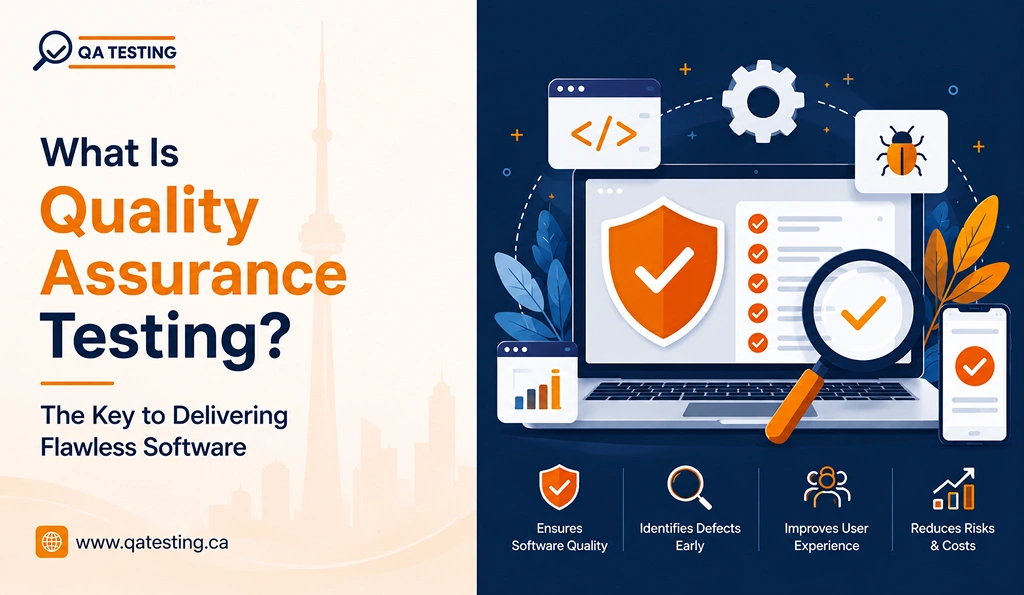
- Quality assurance testing ensures software meets quality standards before release.
- It helps identify defects early and reduces development costs.
- QA improves performance, security, usability, and reliability.
- Automated and manual testing work together for comprehensive coverage.
- Choosing QA testing ensures expert validation and better product outcomes.
Key Points
- With the use of Quality Assurance Testing, the development team can quickly detect any bugs and fix them, thus saving development cost and ensuring a stable application before the release.
- The detailed and thorough QA processes enhance the functionality and usability of the application and also increase its security and compatibility with various devices, browsers, and operating systems.
- Combination of manual testing and automated testing techniques, the software quality can be confirmed with effective Quality Assurance Testing, which leads to speedy release and uninterrupted user experience.
- Quality Assurance Testing helps to reduce business risks and prevent problems after the launch of the application, which costs a large sum to fix and develop customer confidence in the product.
- Choosing a QA Testing service, your business could benefit from expert testers, a tailored QA plan, swift delivery schedules, and highly reliable software.
Why Is Quality Assurance Testing Important?
Software quality influences customer satisfaction, business image, and overall success in business operations. A tiny defect can cause the application to crash, the security of the application to be compromised, a bad customer experience, or even a loss of revenue. Quality assurance testing will identify and fix problems before they can be experienced by end users, so the product can be confidently deployed knowing it will be robust, secure, and functional. A strong QA process helps mitigate risk and ensure quality in development.
1. Early Defect Detection
A main advantage of the Quality Assurance Testing method is that bugs are found early in the software development life cycle. Finding defects before production release is cheaper and more time-efficient than having to fix them post-launch. By early testing, developers can quickly fix and eliminate bugs so there are no project delays, and quality isn’t compromised.
2. Improved User Experience
User experience is another very important aspect of any digital product. Quality assurance tests application behavior, navigation, responsiveness, and usability to ensure the software is user-friendly and users have an excellent experience. Identifying and removing any problems with the usability leads to a seamless experience for the customer, resulting in better engagement and customer loyalty.
3. Enhanced Product Reliability
Users want software that works identically whether used on different devices, through varied browsers, or for numerous purposes. Software QA testing is an examination of an application’s functionality under a wide range of variables and configurations to verify that each feature functions properly and is not causing an unexpected application crash. Quality Assurance Testing makes for dependable and more reliable software and the trust that clients build through it.
4. Increased Security
The threats encountered through cybersecurity keep changing, so testing security becomes a very important part of Quality Assurance Testing. A QA tester will find vulnerabilities, authentication issues, a lack of data security, and opportunities to attack. Remedying these threats before the release of software protects the data and sensitive information of the organization, helps comply with various legal requirements, and maintains the customers’ trust.
5. Cost Savings
Correcting faults once deployed demands urgent updates, more support personnel, and significant amounts of debugging. Quality Assurance Testing saves money by proactively avoiding these issues in the production environment. Preventive QA decreases maintenance costs, reduces operational risks, and allows the organization to allocate its resources efficiently.
6. Faster Time-to-Market
Current development requires quick software releases without sacrificing quality. With automated testing and smooth validation processes, QA testers can perform their tests faster and find bugs earlier. This allows companies to accelerate their development cycles and bring out new features more rapidly, maintaining a competitive advantage with continued quality.
7. Better Business Reputation
Software reliability is about good customer experience and brand image. The application that functions perfectly without glitches and vulnerabilities is guaranteed to get positive reviews, recommendations, and positive feedback. Quality assurance testing helps ensure that the quality of your product is maintained to the standard expected by your customers, hence keeping your brand image healthy.
8. Supports Long-Term Scalability
As products become bigger and more complex, the job of quality becomes exponentially harder. Quality Assurance Testing makes sure that when new features, integrations, and updates are added, they do not have adverse effects on anything currently working. This facilitates sustainable growth and provides businesses with the confidence to grow and scale while still maintaining performance, stability, and user experience.
Also Read: Agentic QA Guide: Smarter AI-Driven Testing & QA
Why Is Quality Assurance Testing Important?
The quality of your software is directly correlated with the satisfaction of customers, the reputation of your business, and long-term survival on the market. When only one simple mistake is made in the code, the software application can crash when it’s used, present risks to your data security, offer poor UX, and eventually cause you financial losses. QA testing lets organizations detect and remove these mistakes before end customers ever get a chance to encounter them, delivering reliable and secure software suitable to be used in practice. Implementing a proper QA approach and strategy will enable you to reduce risks, improve productivity, and ensure business confidence in the quality of your software.
1. Early Defect Detection
A major benefit of Quality Assurance Testing is the discovery of bugs early in the development life cycle. Finding software bugs early saves considerably less time and money than resolving software problems post-release, enabling developers to fix errors quickly and prevent overall project delays without sacrificing software quality.
2. Improved User Experience
User experience is a major contributing factor to the overall success of any digital product. QA testing analyzes the application functions, navigation, performance, and usability, making sure that the users can utilize the software efficiently. After removing the usability problems, businesses are able to deliver a smooth experience to enhance customer satisfaction, engagement, and retention.
3. Enhanced Product Reliability
Users will always expect your software product to behave in the same way, no matter what device/browser/situation they use the product on/in. Quality Assurance Testing checks your application through many situations and ensures it doesn’t fail, making your application more stable and ultimately building user confidence that the product is dependable.
4. Increased Security
Security testing is a continuously developing problem. The testing part of Quality Assurance Testing includes software application security testing. Before deploying the software, the testing teams have to analyze the possible risks involved, like authentication security, data security, and exposure to vulnerability points. Consideration of the same aspects before deploying ensures the security of the company’s data
5. Cost Savings
Emergency patch delivery and more human support resources and troubleshooting are needed for fixes of defects occurring after deployment. The costs associated with these fixes can be lowered by using quality assurance testing and mitigating these problems in the pre-production stages. A good QA methodology lowers maintenance costs and risks and allows more resources to be spent on developing and growing the company.
6. Faster Time-to-Market
Modern development environments demand rapid software releases without compromising quality. Through automated testing and streamlined validation processes, QA teams can execute tests more efficiently and identify issues faster. This enables organizations to accelerate development cycles, release new features more quickly, and remain competitive while maintaining high-quality standards.
7. Better Business Reputation
Reliable software contributes directly to positive customer experiences and stronger brand credibility. Applications that function smoothly and securely are more likely to receive favorable reviews, recommendations, and long-term user adoption. Quality Assurance Testing helps businesses maintain a professional reputation by ensuring products consistently meet customer expectations.
8. Supports Long-Term Scalability
As software grows and evolves, maintaining quality becomes increasingly challenging. Quality Assurance Testing ensures new features, integrations, and updates do not negatively impact existing functionality. This supports sustainable product growth and allows businesses to scale confidently while preserving performance, stability, and user satisfaction.
Read Also: QA as a Service: Types, Process, Benefits & Expert Tips
Types of Quality Assurance Testing
Nowadays, an organization expects to deliver bug-free, secure, smooth, and reliable software that must work consistently across different platforms. To achieve this level of quality, organizations use different types of Quality Assurance Testing that help assess a wide variety of quality aspects of a software’s performance and reliability. The use of many testing types provides an overall quality coverage of the software life cycle.
1. Functional Testing
Functional Testing confirms that all features and functionality in an application work according to specifications defined by business and technical requirements. Testers look at user workflows, validations on inputs, the response from the system, and the logic behind it, and make sure that it works. Functional defects found during this process could affect how users use the system.
2. Manual Testing
Manual Testing means the tests are performed by actual humans without the use of tools or automated scripts. Manual Testing is ideal for performing tests such as usability tests, exploratory tests, or test cases simulating how an actual user would interact with the software. In these situations, testers interact with the software without using scripts and are able to find errors that an automated testing suite may not.
3. Automation Testing
In Automation Testing, test scripts and test frameworks are used to automate repetitive test cases. This provides excellent efficiency, accuracy, and coverage with reduced manual effort. Automation is useful in the context of regression testing, large applications, and continuous integration, where continuous testing has to be done to support the agile development life cycle.
4. Regression Testing
New features, updates, and bug fixes can cause an unintentional change in old functionality. Regression testing makes sure that the old tests still pass and that what was working now still works with the changes that are made. This is useful for keeping the application stable, preventing bugs from recurring, and providing a positive user experience while using updated versions of products.
5. Performance Testing
Performance Testing analyzes application performance under various load conditions and user loads. Performance tests are used to check the critical factors, like response time, speed, scalability, utilization, and stability of the system, to avoid performance bottlenecks before deploying the applications.
6. Security Testing
Security Testing involves identifying weaknesses that can make applications vulnerable to cyber attacks, unauthorized access, and data breaches. Testers look into authentication methods, access control, encryption schemes, and general system security in order to detect weaknesses. This type of testing allows companies to ensure sensitive data is not being compromised and ensures that company regulations are met, thereby increasing customer trust.
7. Compatibility Testing
Users can experience software on a number of different devices, with different browsers, different operating systems, and different screen resolutions. Compatibility Testing can confirm that software works identically under these conditions, without affecting the performance or look and feel of the application.
8. User Acceptance Testing (UAT)
UAT (User Acceptance Testing) is the last stage before going into production. UAT validates that the application works with real business users or stakeholders and meets all business and project goals, and user needs. Successfully testing in UAT is assurance that the application will successfully be used in production to assist in the real business processes.
9. Integration Testing
Integration Testing verifies that different modules, components, APIs, and third-party services work together correctly within the application. It helps identify issues related to data exchange, communication failures, and system interactions. Effective integration testing ensures all connected systems operate seamlessly as a unified solution.
10. Smoke Testing
Smoke Testing is a preliminary testing process performed after a new build is deployed. It validates critical functionalities to ensure the application is stable enough for more extensive testing. By quickly identifying major issues early, smoke testing saves time and prevents unnecessary testing efforts on unstable builds.
Also Read: QA Testing: Key to High-Quality Software Solutions
The Quality Assurance Testing Process
Quality assurance testing is a documented set of techniques that helps in uncovering faults, verifying features, and confirming the compliance of software with the set quality norms before product launch. By implementing a well-organized testing lifecycle, enterprises can mitigate the chances of breakdowns and create a better quality, more dependable product that gives an excellent experience. Each phase in the QA sequence adds to a completely stable, safe, and launch-ready product.
Step 1: Requirement Analysis
The QA process starts with understanding the project requirements and goals. To identify the areas that need testing in the application, QA team members will look at the business requirements, technical specifications, user stories, and functional documents. They will work out test priorities, risks, and expected quality levels from this. Fully grasping the requirements is key to directing QA work.
Step 2: Test Planning
The QA team creates the test plan document, which defines how all testing activities will be carried out. The test plan covers test scope, goals, approach, schedule, resources, tools, test environment, and test exit criteria. Well-documented test plan provides for better resource allocation, risk assessment and uniformity.
Step 3: Test Case Development
Once the strategy has been set out, thorough test cases and test scenarios can be constructed to cover both the functional and non-functional needs of the application. Each test case should contain a step-by-step guide on what test needs to be carried out and what the expected results should be, as well as what criteria must be met. A comprehensive test case will not only test the application, but all the required parts of it at the same time and in different situations.
Step 4: Test Environment Setup
The test environment is set up prior to the actual test; this test environment should resemble the live environment as much as possible. The test environment contains the servers, databases, applications, devices, browsers, and network setup. Once the test environment is set up like this, the software can be tested in terms of performance, and flaws can be identified as they could happen live.
Step 5: Test Execution
QA team executes the manual and automatic test cases to ensure the behavior, performance, security, usability, and compatibility of the application. By executing the tests, we will find out the defects, performance, broken flows, and abnormal behavior of the system. Testers can check and test the application in all possible ways to ensure each and every function is tested as required.
Step 6: Defect Reporting and Tracking
Where the defects are found, these are reported and tracked using defect management tools. Details are recorded on every issue, including severity level, screenshots, steps to reproduce, expected results, actual results, and so on. Correct defect tracking means the developer can easily understand the issue, fix it in order of priority, and communicate where it is.
Step 7: Retesting and Validation
Once the defects are fixed by developers, QA engineers then conduct re-testing in order to ascertain that the issues raised have indeed been corrected. Regression testing is carried out to confirm that recent changes have not had adverse effects on previously tested functionalities.
Step 8: Test Closure
The last step of Quality Assurance Testing is the final review of all testing activities, assessing the overall quality of the software. QA groups prepare comprehensive reports that cover test execution status, defect counts, coverage data, and release readiness, enabling stakeholders to know whether or not the software is ready for release and learn from the development of this application.
Read Also: Top Digital Accessibility Testing Companies
Best Practices for Effective Quality Assurance Testing
To create and launch high-quality software products successfully, more is required than simply discovering and repairing software defects. Companies must use a planned Quality Assurance Testing methodology in an attempt to anticipate problems and maximize efficiency throughout the development cycle, with the ultimate goal of achieving continuous improvement. Following good QA practices will help organizations launch reliable software, speed up development times, minimize risks, and provide the most enjoyable user experience. The following practices enable maximum effective use of quality assurance testing efforts.
1. Integrate QA Early in Development
One of the key QA strategies is implementing a shift-left testing policy, which involves starting tests at the very beginning of the software development process. Instead of testing at the end of the project when everything has already been developed, QA teams participate in the requirement gathering, design, and coding phases, so defects can be detected early, and project risks are lowered, reducing project expenses and time and improving software quality.
2. Automate Repetitive Testing Tasks
In current Quality Assurance Testing, Automation holds a significant position. Time-consuming and repetitive tests like regression testing, performance tests, and smoke tests can be performed automatically. Automated testing lessens manual effort, enhances test coverage and efficiency, removes the human element of testing, and helps gather faster feedback for development.
3. Maintain Comprehensive Test Coverage
Quality Assurance testing needs to cover all important aspects of an application. This covers function, security, performance, compatibility, usability, and reliability. Good test coverage means that all aspects of a feature will be tested across various environments and scenarios. By looking at an application from various viewpoints, the team will find bugs that otherwise would have been unnoticed, which lowers risk in production.
4. Prioritize High-Risk Areas
The risk level of the components involved in the application can differ; a risk-based approach helps to identify which components are more critical. Business-critical workflows, payment gateway modules, user authentication modules, and client applications are some of the parts that might significantly affect operations and user satisfaction. By applying this strategy, QA can allocate resources appropriately, and the identified risky parts would be tested thoroughly to enhance application robustness.
5. Continuously Monitor Quality Metrics
Performance metrics of the testing effort should be quantified in order to keep track and improve. These metrics could include defect density, test coverage, success/fail rates, defect turnaround time, readiness for release, etc. The values measured provide a detailed picture of the quality of the software and enable QA teams to understand the development of trends, test effectiveness, and thus drive decisions for better development cycles.
6. Foster Strong Team Collaboration
Quality is a team effort throughout the whole software development lifecycle. Clear communication and collaboration among the developers, testers, product managers, business analysts, and stakeholders make issue identification and resolution happen at an earlier stage and at a faster pace. These practices result in sharing knowledge, understanding requirements clearly, and maintaining alignment in project objectives and quality expectations throughout the entire life cycle.
7. Regularly Update Test Cases
When the software evolves, the documentation for testing needs to adapt. QA teams should routinely review test cases and update them to ensure that they accurately reflect new functionalities, system changes, and new business requirements. This keeps test cases up-to-date and relevant, ensuring accurate test coverage and avoiding key functionalities being missed during upcoming releases.
8. Use Realistic Test Data
Using real-world data in testing can also allow teams to simulate real user actions and production environments. Real-world test scenarios can produce test results more representative of the actual performance and help to uncover bugs which would not be caught by using generic test data.
9. Continuously Improve Testing Processes
An organization must be able to assess its strengths and weaknesses of the Quality Assurance Testing process and see the process of testing as a cycle of continuous improvement and not an isolated event. Periodically analyzing the testing results, pinpointing the bottlenecks, classifying the bugs, and exploring newer techniques or tools enables the organization to improve the quality of its QA process.
Also Check: Offshore Software Testing: Benefits, Challenges, & Insights
Future Trends in Quality Assurance Testing
QA testing is evolving with the software development revolution. While before it was a separate and manual process, it is now digital, automated, and one of the features of the development cycle. As new technologies are coming up and users’ needs are changing, the solution to software quality is also changing. Only organizations that recognize upcoming trends and effectively use them will optimize testing, have quicker product launches, and deliver superior customer experiences on digital platforms
1. AI-Powered Testing
AI is significantly improving Quality Assurance Testing as it can automate the generation, execution, and maintenance of tests as well as identify defects. Tools powered by AI can examine how an application is performing, predict areas likely to fail, and write the necessary tests for this.
2. Increased Test Automation
Automation will further be adopted in software testing due to the organizational need to deliver at a faster pace with continued delivery. More complex test cases will be carried out by advanced automation frameworks, thus reducing the monotonous and repetitive manual testing.
3. Shift-Left and Shift-Right Testing
The way modern teams are going about testing and developing is evolving beyond traditional testing models to encompass both shift-left and shift-right testing. The shift-left perspective to testing addresses the need to validate quality early in the software development lifecycle, while the shift-right perspective to testing concerns monitoring production behavior and quality of the applications running live
4. Continuous Testing in DevOps
In the era where DevOps and CI/CD pipelines have become mandatory, continuous testing is gaining more importance as the primary QA strategy. Automated tests have been woven into each phase of the development and deployment process so that any issue detected with the code quality can be immediately corrected.
5. Cloud-Based Testing Environments
Cloud-based testing tools are becoming increasingly adopted by organizations because they are adaptable, expandable, and affordable. These platforms enable QA engineers to test applications on various devices, browsers, operating systems, and locations simultaneously, thus saving on hardware.
6. Enhanced Security Testing
As cyber-attacks are becoming more and more complex, security testing will stay one of the major concerns in an organization. Automated vulnerability scanning, penetration testing, compliance verification, and continuous security monitoring will be part of the QA strategies in the future to safeguard crucial data and ensure users’ reliance on your products.
7. IoT and Connected Device Testing
With the exponential increase in connected IoT devices, new testing challenges are arising. QA teams have the responsibility to test and verify connectivity, interoperability, performance, and security across the myriad of smart devices, sensors, and networks, providing users with smooth experiences.
8. Low-Code and No-Code Test Automation
There are now low-code and no-code testing platforms that bring the benefit of automation to the non-technical user. They allow Business Analysts, QAs, and Product teams to create automated tests with little coding skill and therefore improve teamwork and reduce time on automation testing projects.
9. Predictive Analytics for Quality Assurance
Data-driven testing is likely to become a bigger factor as organizations develop the capability to use predictive analytics to identify potential issues before any defect occurs. Using historical test data and application usage characteristics, QA can ensure optimal testing coverage and enhance product quality.
10. Real User Experience Monitoring
The future of QA will not be solely limited to testing prior to product release, but also to actively observing and evaluating the end user’s experience. The application of real-time analysis and application monitoring tools would aid organizations in identifying performance problems, user-friendliness issues, and customer struggles.
Read Also: QA Testing Guide: Process, Examples & Best Practices
Why Choose QA Testing?
Software quality is also crucial in today’s digital competitive market and is a significant part of the satisfaction of the customers, growth of business, brand recognition, and business development. Defects of any kind can result in degrading user experience, distrust of the customer, additional costs after release, and more. Working with the right QA provider can make sure that the software you launch is properly tested, and it works fine in the production environment so it performs efficiently. QA Testing provides robust quality assurance solutions that help companies to launch reliable, secure, and high-performance software products with full confidence.
1. Experienced QA Specialists
QA Testing has the support of experienced and expert QA professionals with domain expertise in Web applications, mobile applications, enterprise applications, SAAS based applications, and emerging technologies, which will aid in predicting and identifying any impending defects, along with having the skills to effectively test and deliver quality.
2. Comprehensive Testing Services
Every software product has unique quality requirements. QA Testing offers a complete range of testing services, including manual testing, automation testing, regression testing, performance testing, security testing, compatibility testing, and user acceptance testing. This end-to-end approach ensures every aspect of your application is thoroughly evaluated and validated.
3. Advanced Testing Methodologies
QA Testing strictly adheres to recognized industry testing systems, best practices that have been proven over time, and contemporary quality assurance approaches that result in accurate and reliable outcomes. Aside from using the most up-to-date tools, technologies, and testing methods, the team tries to provide a great extent of coverage during testing while also working on the efficiency of the whole software development lifecycle.
4. Faster Release Cycles
The speed of anything is extremely important in modern times of fast-moving technology. QA Testing through improved testing processes and smart automation techniques helps companies to cut down the time of testing and speed up the software delivery. Less time spent on testing enables the business to be able to constantly release new features and updates without any impact on the product quality.
5. Improved Product Reliability
A reliable application creates a better user experience and strengthens customer confidence. QA Testing performs rigorous validation across functionality, performance, security, and compatibility to minimize defects and ensure stable operation under real-world conditions. This results in software that performs consistently and meets user expectations.
6. Customized QA Solutions
No two projects are the same, which is why QA Testing develops tailored testing strategies based on specific business objectives, technical requirements, industry standards, and target audiences. This personalized approach ensures testing efforts focus on the areas that matter most to your product’s success.
7. Cost-Effective Quality Assurance
Identifying defects early in development is significantly less expensive than fixing issues after deployment. QA Testing helps organizations reduce maintenance costs, avoid costly production failures, and minimize operational risks by proactively detecting and resolving problems before they impact users.
8. Seamless Collaboration and Transparency
QA Testing works closely with development teams, project managers, and stakeholders throughout the testing process. Clear communication, detailed reporting, and transparent workflows ensure everyone remains informed about testing progress, identified issues, and overall product quality, leading to faster resolutions and more successful project outcomes.
9. Scalable Testing Support
Whether you’re launching a startup MVP, enhancing an existing application, or managing a large-scale enterprise platform, QA Testing provides scalable testing solutions that adapt to changing project requirements. This flexibility allows businesses to maintain quality standards as their products grow and evolve.
Conclusion
Quality Assurance Testing is far more than a final checkpoint before software release, it is a strategic process that ensures applications are reliable, secure, high-performing, and aligned with user expectations. By incorporating QA throughout the software development lifecycle, businesses can identify defects early, reduce development costs, improve product stability, and deliver seamless user experiences across platforms and devices.
As modern applications continue to grow in complexity, maintaining consistent software quality has become a critical business requirement rather than an optional practice. Organizations that invest in comprehensive Quality Assurance Testing are better positioned to minimize risks, accelerate release cycles, strengthen security, and build long-term customer trust.
Whether you’re developing a startup MVP, a mobile application, a SaaS platform, or an enterprise solution, a robust QA strategy plays a vital role in ensuring product success. By partnering with QA Testing, businesses gain access to experienced QA specialists, advanced testing methodologies, and customized quality assurance solutions designed to deliver reliable software, faster deployments, and exceptional user satisfaction at every stage of development.
FAQ
1. What is Quality Assurance Testing?
Quality Assurance Testing is a structured process that verifies software quality, functionality, performance, security, and usability before deployment. It helps ensure applications meet technical requirements and user expectations while minimizing defects and operational risks.
2. Why is Quality Assurance Testing important?
Quality Assurance Testing improves software reliability, reduces development costs, enhances user experiences, identifies security vulnerabilities, and helps organizations deliver stable products with greater confidence and fewer post-release issues.
3. What are the main types of QA testing?
Common QA testing types include functional testing, manual testing, automation testing, regression testing, performance testing, security testing, compatibility testing, and user acceptance testing. Each addresses specific quality requirements and software risks.
4. How does automation help in Quality Assurance Testing?
Automation testing speeds up repetitive test execution, improves testing consistency, increases coverage, reduces human error, and supports faster software releases through continuous integration and continuous delivery workflows.
5. Why should businesses choose QA Testing?
QA Testing provides experienced specialists, comprehensive testing services, customized quality strategies, advanced methodologies, and efficient testing processes that help businesses deliver reliable, secure, and high-performing software products.

Pankaj Arora
Founder, QA Testing

Pankaj Arora is a seasoned technology leader and the Founder of QA Testing, with over 10+ years of experience in delivering high-quality software testing solutions. He specializes in quality assurance strategy, automated testing, AI-driven validation, and performance optimization. Under his leadership, QA Testing has become a trusted partner for startups and enterprises, ensuring secure, reliable, and seamless quality assurance across web, mobile, and enterprise applications.